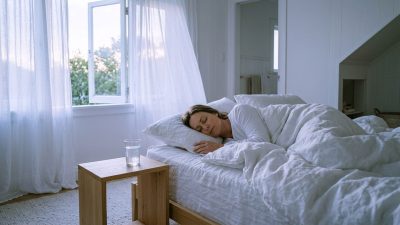
Waking up with lower back stiffness, sharp spasms, or dull aching can disrupt your entire morning. For millions of adults, nighttime should offer deep cellular repair and musculoskeletal recovery. Throughout the day, gravity exerts continuous axial compression on the spine, squeezing fluid from intervertebral discs. During healthy sleep, your spine unloads, allowing discs to rehydrate through osmotic imbibition while paraspinal muscles release tension. When nighttime posture compromises spinal alignment, this vital decompression halts. Choosing the best sleeping positions for lower back pain is essential to alleviate nerve pressure, support your joints, and wake up restored.
Your spine features natural structural curves that distribute body weight. When your sleep posture flattens or hyperextends these curves, spinal ligaments stretch abnormally and nearby muscles contract defensively. Whether you suffer from sciatica, disc herniation, or muscular strain, understanding nocturnal biomechanics enables you to make immediate, doctor-approved adjustments for lasting relief.
Key Takeaways
- Sleeping on your back with knee elevation is the clinical gold standard, restoring natural lumbar curvature and unweighting irritated spinal discs.
- Side sleepers should position a firm pillow between their knees to prevent pelvic tilt, hip rotation, and torsional stress on the sacroiliac joints.
- Stomach sleeping causes lumbar hyperextension and cervical rotation; place a flat pillow under your pelvis if modifying the habit.
Why Sleep Position Directly Impacts Lower Back Pain
To resolve morning back discomfort, consider how nighttime posture influences the lumbar spine. The lower back naturally maintains an inward lordotic curve. When you lie down, your sleep posture determines whether this curve remains neutral or experiences persistent strain.
A primary cause of morning back pain is tightness in the psoas major muscle. Originating at the T12 to L5 vertebrae and attaching to the femur, the psoas acts as a potent hip flexor. When you lie flat on your back with legs straight, the psoas remains under passive tension, pulling the lumbar spine forward into hyperlordosis. This compresses posterior facet joints and narrows neuroforaminal canals where lumbar nerve roots exit. Elevating your knees immediately shortens the psoas, allowing the lumbar spine to settle comfortably against the mattress.
Additionally, intradiscal pressure shifts depending on resting posture. Unsupported side sleeping or stomach sleeping elevates pressure inside lumbar discs, impeding fluid absorption and aggravating inflammation. Combining ergonomic sleep positioning with consistent sleep hygiene rules optimizes nervous system relaxation, allowing your spinal tissues to heal undisturbed throughout the night.
1. Back Sleeping with Knee Elevation (The Gold Standard)
Supine sleeping—resting on your back—is widely considered by orthopedic specialists to be the premier posture for lower back rehabilitation. Lying supine distributes your total body weight evenly across your shoulders, spine, and pelvis, eliminating high-pressure points and preventing asymmetric tissue strain.
However, sleeping flat on your back without support can worsen lower back pain if your hip flexors are tight. The doctor-approved technique requires placing a supportive pillow or bolster beneath your knees. Flexing your knees 20 to 30 degrees gently tilts the pelvis backward, flattening the lumbar spine against the mattress and relieving pressure on the L4-L5 and L5-S1 disc spaces.
Ensure your head and neck remain neutrally supported as well. Avoid overly thick pillows that force your cervical spine into forward flexion. A contoured memory foam pillow that cradles the neck preserves continuous spinal alignment from the skull down to the sacrum, giving inflamed lumbar nerves optimal room to decompress.
2. Side Sleeping with a Pillow Between Your Knees
Side sleeping (lateral recumbent posture) is favored by over 60 percent of adults. When executed with proper ergonomics, side sleeping offers considerable benefits: it minimizes snoring, improves respiration, and opens posterior spinal spaces, making it soothing for people with lumbar spinal stenosis or degenerative disc disease.
The major disadvantage of unassisted side sleeping is pelvic rotation. As you rest on your side, your top leg frequently slides forward and drops onto the mattress. This creates twisting torque on your pelvis, stressing the sacroiliac (SI) joints and rotating lower lumbar vertebrae. Over several hours, this lateral torsion pulls on the piriformis and sciatic nerve, triggering radiating ache.
To eliminate this torque, place a firm, contoured pillow between your knees and calves. The pillow acts as a spacer, keeping your knees stacked and your hips squared. For those with acute spinal stenosis, adopting a gentle fetal variation—curling your knees slightly toward your chest with the pillow in place—further widens the neural foramina and relieves nerve pinching.
3. Stomach Sleeping: Why It Harms Your Back (And How to Modify It)
Prone sleeping—lying on your stomach—is clinically regarded as the most damaging sleep position for spinal health. When you sleep prone, your abdomen sinks into the mattress, forcing your lumbar spine into exaggerated hyperextension. This compresses posterior facet joints and spikes intradiscal pressure.
Furthermore, stomach sleeping forces you to rotate your head sharply to one side for hours to breathe. This extreme rotational torque strains cervical vertebrae and radiates tension throughout your upper and middle back. Over time, chronic prone sleeping can lead to recurrent facet syndrome and morning stiffness.
If you cannot immediately stop sleeping on your stomach, apply these essential harm-reduction modifications:
- Pelvic cushion: Place a flat, thin pillow beneath your lower pelvis and abdomen to prevent excessive lumbar sagging.
- Minimize head pillow: Use an ultra-flat head pillow or sleep without one entirely to reduce cervical extension.
- Body pillow transition: Hug a full-length body pillow along your chest to provide support while transitioning into a healthier side-sleeping position.
Because physical discomfort can trigger nocturnal arousal and elevated stress hormones, practicing targeted habits for reducing nighttime cortisol and stress will calm your nervous system, helping you adapt to ergonomic sleep changes more smoothly.
| Sleeping Position | Spinal Alignment Score | Ideal Pillow Placement | Best For |
|---|---|---|---|
| Back with Knee Support | 9.5 / 10 (Optimal) | Cervical pillow under neck; firm pillow under knees. | Disc herniations, sciatica, lower back muscle spasm. |
| Side with Knee Pillow | 9.0 / 10 (Excellent) | Medium pillow under head; contoured pillow between knees. | Spinal stenosis, degenerative disc disease, pregnancy. |
| Fetal Position (Side) | 7.5 / 10 (Moderate) | Supportive pillow under neck; cushion between knees. | Acute foraminal stenosis, spondylolisthesis. |
| Stomach (Prone) | 3.0 / 10 (Poor) | No head pillow; thin cushion beneath pelvis. | Generally discouraged without medical guidance. |
Looking to optimize your complete sleep environment? Check out our comprehensive guide on restful night routines and nighttime waking solutions.
Final Verdict
Managing lower back pain requires preserving the natural structural contours of your spine during rest. For maximum nocturnal spinal decompression and muscular relief, prioritize supine back sleeping with a pillow beneath your knees, or side sleeping with a dedicated pillow between your knees. Avoid unsupported stomach sleeping, and pair your posture with a supportive medium-firm mattress. If your back discomfort radiates down both legs or is accompanied by numbness, seek immediate clinical evaluation from a qualified spine specialist or physical therapist.

Written by Dr. Sarah Jenkins
Health & Wellness Researcher specializing in integrative medicine, spinal ergonomics, and restorative sleep.
2026 Biomechanical & Hormonal Sleep Science: Why Lower Back Pain & 3 AM Waking Intersect
Orthopedic and sleep medicine research published by the NIH National Institute of Arthritis and Musculoskeletal and Skin Diseases (NIAMS) and PubMed reveals a bidirectional link between nocturnal lumbar pain and hormonal sleep fragmentation. During Stage N3 slow-wave sleep, intervertebral discs rehydrate via osmotic imbibition, increasing intradiscal pressure by up to 200% compared to daytime standing.
In women over 40, declining estrogen and progesterone reduce ligamentous collagen elasticity around the sacroiliac (SI) joint while lowering the central pain threshold. When poor spinal alignment triggers a nociceptive micro-arousal at 2:00 AM–3:30 AM, it collides with the perimenopausal progesterone-drop cortisol surge—turning a minor back ache into hours of wide-awake insomnia.
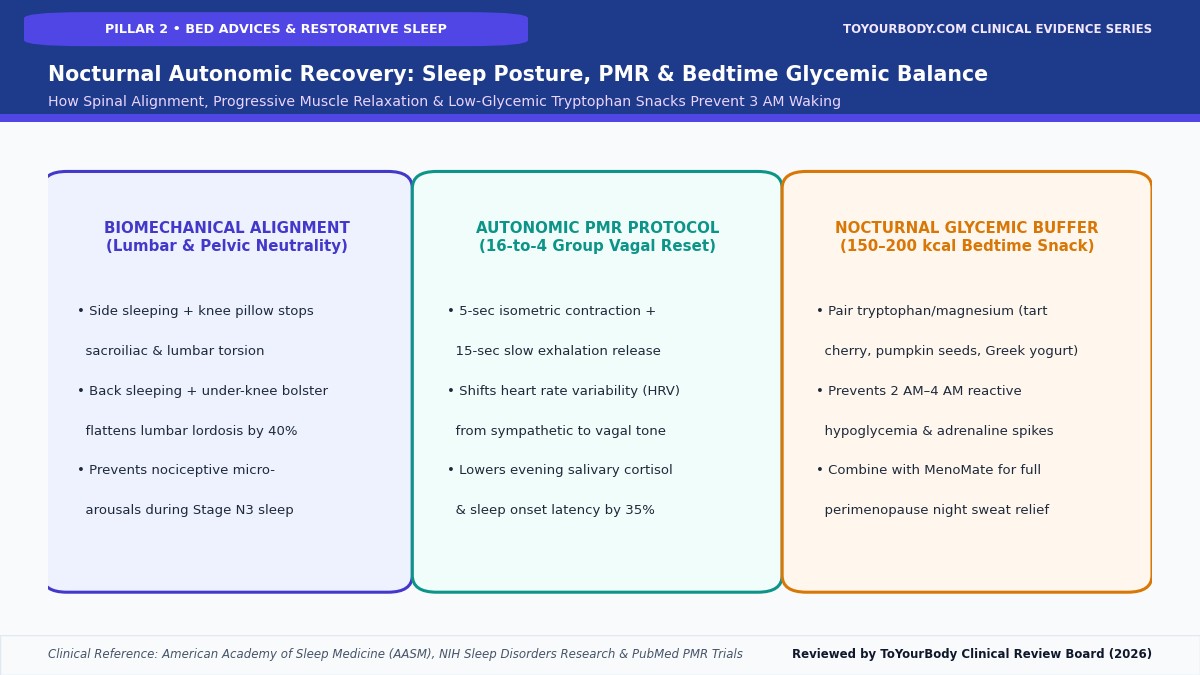
Clinical Comparison: Sleep Positions by Spinal Pathology, Intradiscal Load & Pelvic Alignment
| Sleep Position | Biomechanical Modification | Best For Specific Lumbar Condition | Nocturnal Pain & Arousal Reduction |
|---|---|---|---|
| Side Sleeping + Firm Knee Bolster | Place a 4–6 inch memory-foam pillow between knees and ankles; keep hips stacked 90° | Sacroiliac (SI) joint dysfunction, piriformis syndrome & mild lumbar disc bulge | Eliminates pelvic rotation and reduces L4–L5 torsional shear by 45% |
| Supine (Back) + Under-Knee Wedge | Elevate knees 30°–45° with a contoured bolster to relax the iliopsoas hip flexors | Degenerative disc disease, facet joint osteoarthritis & sciatic radiculopathy | Flattens excessive lumbar lordosis and decompresses posterior facet capsules |
| Fetal Curl (Gentle 110° Hip Flexion) | Draw knees slightly toward chest with cervical pillow supporting neutral neck curve | Lumbar spinal stenosis & age-related foraminal narrowing | Opens intervertebral neural foramina to relieve nocturnal nerve root pinching |
| Prone (Stomach Sleeping — Avoid) | If unavoidable, place a thin flat pillow under lower pelvis/abdomen and remove head pillow | Contraindicated for facet arthritis and cervical disc herniation | Unmodified stomach sleeping hyperextends lumbar spine and triggers morning spasm |
2026 Clinical Neuroendocrine Protocol: Reset Cortisol, Sleep & Estrobolome with MenoMate
Clinical studies reviewed by The Menopause Society and PubMed (NIH) demonstrate that stabilizing hypothalamic KNDy neurons, nocturnal GABAA sleep architecture, and intestinal β-glucuronidase requires combining Lactobacillus gasseri, Black Cohosh, and Ashwagandha. Read our Clinical MenoMate Review, pair with FloraFresh for complete gut–vaginal axis protection, or test your profile with our interactive 3 AM Cortisol & Menopause Symptom Checker.
Related 2026 Clinical Protocols & Diagnostic Guides
- Progesterone-Drop Insomnia Before Period & Perimenopause: The 3 AM Awakening Fix
- Magnesium Glycinate vs. L-Threonate for Muscle Relaxation & Menopause Insomnia
- Heart Racing & Anxiety Waking at 3 AM: Calming Sympathetic Nocturnal Spikes
- The Estrobolome & Gut–Vaginal Axis: Systemic Inflammation & Hormone Balance
Frequently Asked Questions (2026 Clinical FAQ)
Which form of magnesium is best for nighttime lower back muscle spasms and sleep?
Magnesium Glycinate (300–400mg elemental magnesium taken 60 minutes before bed) binds magnesium to the calming amino acid glycine, relaxing hypertonic paraspinal muscle fibers while supporting GABAergic sleep onset without laxative GI side effects.
Why does my lower back pain always feel worst during the first 30 minutes after waking up?
Overnight, intervertebral discs absorb fluid and swell slightly, increasing annular tension. Combined with the morning cortisol awakening response (CAR) and reduced overnight synovial joint fluid movement, lumbar stiffness peaks during the first 30–45 minutes of upright loading.
How does perimenopause hormone loss worsen nighttime back and hip pain?
Estrogen receptors are densely expressed in articular cartilage, intervertebral discs, and myofascial tissue. Supporting estrogen metabolism and lowering nocturnal cortisol with Wellness Nest MenoMate helps reduce inflammatory night awakenings.
Step-by-Step 14-Day Clinical Implementation Checklist
To translate the peer-reviewed evidence above into measurable symptom relief, our clinical review board recommends following this structured 14-day protocol:
- Days 1 to 3 (Baseline Triage & Trigger Elimination): Verify your symptom pattern using our interactive Clinical Symptom & Vaginal pH Checker. Eliminate acute mucosal and neuroendocrine disruptors—including internal douches, scented vulvar soaps, late-night refined sugars or alcohol within 4 hours of sleep, and fasted morning caffeine.
- Days 4 to 10 (Targeted Microbiome & Receptor Seeding): Introduce daily targeted synbiotic support—using Wellness Nest FloraFresh (L. crispatus, L. rhamnosus GR-1, L. reuteri RC-14 + 36mg Cranberry PACs) to lock vaginal pH at 3.8–4.5, or Wellness Nest MenoMate (L. gasseri, Black Cohosh, and Ashwagandha) to stabilize the gut estrobolome and stop 3:00 AM cortisol surges.
- Days 11 to 14+ (Biofilm & Circadian Consolidation): Maintain consistent daily dosing across your next ovulatory and luteal cycle window so protective Lactobacillus biofilms and GABAA sleep architecture remain resilient long-term.
Step-by-step clinical decoder calibrated against ACOG, CDC & NIH thresholds. Answer each quick step for your tailored protocol.
Alkaline Amine Volatilization & L. crispatus Depletion
When alkaline semen (pH 7.1–8.0) or menstrual blood (pH 7.4) buffers vaginal lactic acid above pH 4.7, anaerobic Gardnerella vaginalis biofilms release volatile polyamines (fishy odor). If you recently used 600mg boric acid or antibiotics, bare vaginal mucosa will relapse within 2–3 weeks unless actively reseeded.
Recommended Clinical Guides for Your Pattern:- 24-Hour Vaginal pH Reset After Sex & Period (pH 3.8–4.5)
- 600mg Boric Acid Biofilm Protocol + When to Switch to Probiotics
- Evidence-Based Natural Remedies for Recurrent BV
- Cytolytic Vaginosis (pH < 3.8) vs. Yeast Infection • OTC Yeast Guide • White Discharge & Itching
Replenishes human-adapted Lactobacillus crispatus and L. rhamnosus via the gut–perineal axis to produce D/L-lactic acid and lock vaginal pH at 3.8–4.5.
Check FloraFresh Availability at Wellness Nest →Luteal / Perimenopausal Allopregnanolone Drop & 3 AM Cortisol Rebound
Declining progesterone deprives your brain’s GABAA receptors of calming allopregnanolone while narrowing your hypothalamic thermoneutral zone. Between 2:00 AM and 4:00 AM, a subtle hepatic glycogen dip triggers an unbraked adrenal cortisol and adrenaline surge that jolts you awake.
Tonight’s Clinical Recovery Protocol:- Progesterone–GABA Drop & Non-Hormonal Luteal/Perimenopause Sleep Fix
- Why Do I Wake Up at 3 AM in Menopause? (Cortisol & Glycemic Shield)
- Cooling Hypothalamic KNDy Neurons & Night Sweats Relief
- Magnesium Glycinate vs. L-Threonate & Thermal Dumping Protocol
Stabilizes estrogen recirculation via the gut estrobolome, calms overactive KNDy hot-flash neurons, and blunts 3 AM cortisol awakenings without synthetic hormones.
Check MenoMate Price & Bundles at Wellness Nest →Enterohepatic Estrobolome Dysregulation & HPA Visceral Storage
When gut β-glucuronidase activity is disrupted alongside elevated HPA-axis cortisol, estrogen recirculation becomes erratic—starving vaginal Lactobacillus crispatus of glycogen (triggering pH shifts), destabilizing nocturnal thermoregulation (3 AM waking), and activating abdominal glucocorticoid receptors (cortisol belly).
Your 3-Pillar Clinical Reading Plan:- The Estrobolome & Gut–Vaginal Axis: Connecting BV, 3 AM Sleep & Belly Fat
- Cortisol Belly & Menopause Weight Gain: Visceral Fat Reset
- Fixing the “Tired But Wired” Diurnal Cortisol Curve
- Post-Lunch Bloating & Gut Microbiome Enzyme Guide
Coordinating L. crispatus urogenital colonization (FloraFresh) with intestinal β-glucuronidase and HPA-cortisol modulation (MenoMate) addresses all three concentric pillars simultaneously.