
It’s a frustratingly common scenario: you fall asleep without much trouble, only to jolt awake staring at the ceiling just as the clock strikes 3 AM. If you are in your late thirties or forties, this isn’t just a random bout of insomnia. This specific middle-of-the-night awakening is a classic hallmark of perimenopause, driven by a complex interplay of shifting hormones, blood sugar, and stress responses.
Understanding the physiological reasons behind these disruptions is the first step to reclaiming your rest. By making targeted changes to your routine, you can teach your body to sleep through the night again.

Key Takeaway
- Waking up at 3 AM during perimenopause is often triggered by cortisol spikes attempting to compensate for sudden blood sugar drops.
- Declining estrogen affects the brain’s ability to maintain a steady sleep cycle and regulate temperature.
- Supporting your gut microbiome and adjusting evening habits can significantly reduce these middle-of-the-night disruptions.
The Cortisol and Blood Sugar Connection
Between 2 AM and 4 AM, your blood sugar naturally dips to its lowest point. In a perfectly balanced system, your liver steadily releases stored glycogen to maintain energy. However, declining estrogen levels can make your body more insulin resistant and less efficient at managing these drops. When blood sugar plummets, your brain panics and releases a surge of cortisol—the stress hormone—to force the liver to release glucose. This sudden rush of cortisol instantly pulls you out of deep sleep. To prevent this, consider late-night snacks that support better sleep, like a spoonful of almond butter, to stabilize blood sugar overnight.
The Role of Dropping Progesterone
Progesterone is your body’s natural relaxation hormone. It stimulates the production of GABA, a calming neurotransmitter that promotes deep, restorative sleep. During perimenopause, progesterone levels often drop sharply and erratically. Without enough of this soothing hormone, your brain remains in a state of hyper-arousal, making it incredibly easy to wake up at the slightest noise or temperature shift.
Hot Flashes and Core Temperature
Estrogen helps regulate the hypothalamus, the brain’s internal thermostat. As estrogen fluctuates, the brain can misinterpret normal body heat as an extreme threat, triggering an immediate and intense cooling response—the infamous night sweat. The sudden heat and subsequent shivering almost always interrupt the sleep cycle. If night sweats are your primary trigger, exploring non-hormonal options for menopause symptoms can help provide relief without synthetic hormones.

The Liver’s Processing Hour
In traditional Eastern medicine, the hours between 1 AM and 3 AM are associated with the liver’s natural detoxification cycle. Interestingly, modern biology agrees that the liver is highly active during this time, processing the day’s hormones and toxins. If your liver is overburdened by alcohol, excess sugar, or a sluggish gut microbiome, this metabolic effort can generate enough internal heat and stress to wake you up. Reducing alcohol intake before bed can drastically improve sleep continuity.
An Overactive Nervous System
If you wake up at 3 AM with a racing heart and a mind full of to-do lists, your nervous system is stuck in fight-or-flight mode. Because the hormonal buffer of estrogen is weakening, you are more susceptible to daily stressors. Implementing a progressive muscle relaxation routine right before bed can help manually down-shift your nervous system into a parasympathetic (rest and digest) state.
Gut Health and Melatonin Production
Your gut microbiome is responsible for producing a massive amount of serotonin, which is eventually converted into melatonin, your primary sleep hormone. When perimenopause alters the gut flora, melatonin production can become erratic, leading to fragmented sleep. By introducing specific, clinically studied probiotic strains, you can help stabilize this gut-brain connection. Many women have found success exploring how MenoMate works for menopause sleep support.
If you want to explore the optional support layer, check the current MenoMate offer here.
Final Verdict
Waking up at 3 AM during perimenopause is a complex issue driven by fluctuating hormones, cortisol spikes, and blood sugar crashes. You don’t have to just accept exhaustion as a normal part of aging. By stabilizing your evening blood sugar, optimizing your sleep environment, and supporting your gut microbiome with tools like MenoMate, you can significantly reduce these mid-night awakenings and wake up feeling refreshed.
Related Guide: If you want to dive deeper, read our comprehensive guide on 5 Sleep Hygiene Rules Every Woman Over 40 Must Follow.
2026 Chronobiology Deep-Dive: The 3:00 AM Progesterone, Glycemic & KNDy Collision
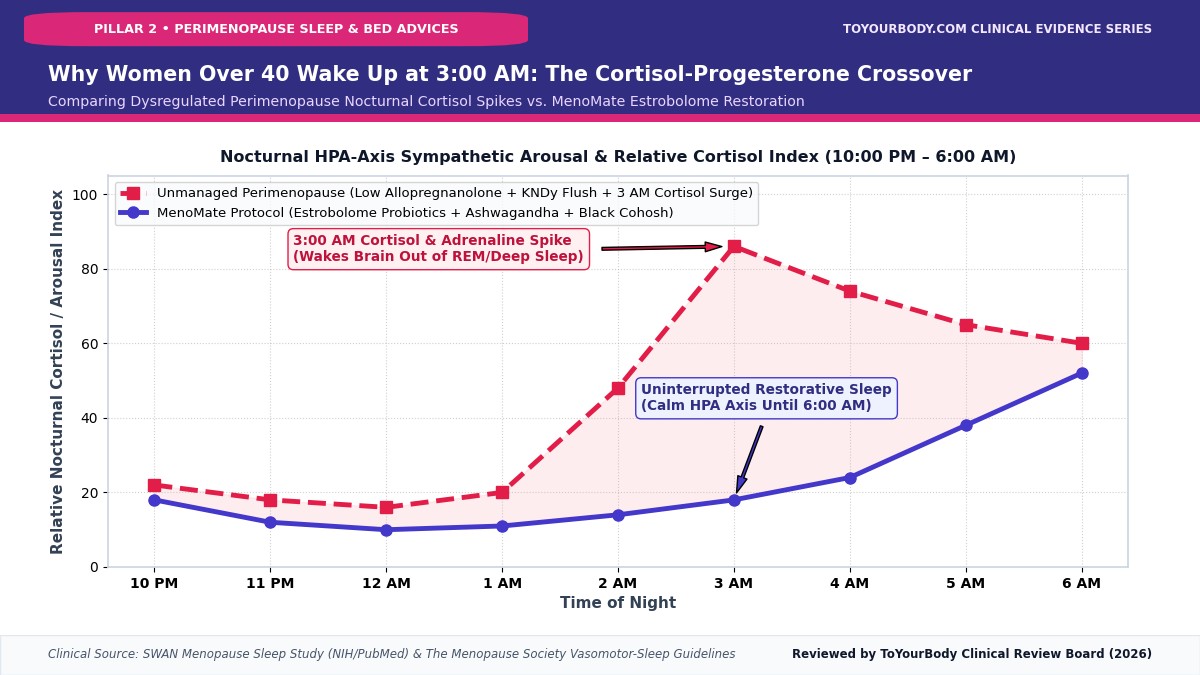
Waking up at 2:30 AM to 3:30 AM with your eyes wide open and mind racing is the single most common neuroendocrine signature of perimenopause. According to The Menopause Society and NIH sleep architecture studies, 3:00 AM is the exact circadian inflection point where your body transitions from deep slow-wave sleep (Stage N3) into longer REM cycles—and where your adrenal glands naturally begin prepping the early-morning cortisol rise.
When perimenopause depletes allopregnanolone (progesterone’s calming GABAA neurosteroid), three triggers converge at 3:00 AM: (1) unbuffered hypothalamic KNDy neurons fire a subclinical or drenching thermal flush, (2) late-night carb or alcohol metabolism triggers a reactive blood glucose dip that releases emergency adrenaline, and (3) unopposed cortisol jolts your amygdala awake with heart-racing anxiety.
Diagnostic Matrix: Identifying Your Exact 3:00 AM Perimenopause Awakening Trigger
| 3 AM Awakening Subtype | Signature Physical Symptoms at 3 AM | Root Neuroendocrine Driver | Exact Evening Reset Protocol |
|---|---|---|---|
| 1. Vasomotor / KNDy Surge | Waking hot, kicking off covers, damp neck/chest sweat, sudden warmth | Low estradiol narrows hypothalamic KNDy thermoneutral zone | Daily Wellness Nest MenoMate + 65°F (18°C) bedroom + breathable bamboo sheets |
| 2. GABA / Progesterone Drop | Worst 7–10 days before period; brain instantly ruminating; cannot fall back asleep | Withdrawal of luteal allopregnanolone GABAA receptor inhibition | MenoMate (Ashwagandha) + Magnesium Glycinate/L-Threonate |
| 3. Reactive Hypoglycemia Spike | Pounding heartbeat, shaky hands, vivid nightmares after evening wine or pasta | Nocturnal blood glucose drop (<75 mg/dL) triggers adrenal epinephrine/cortisol rescue | Eliminate evening alcohol; eat a protein-fat bedtime buffer (Greek yogurt/pumpkin seeds) |
| 4. Nocturia & Urogenital pH Shift | Waking at 3 AM needing to urinate + urethral irritation or vaginal dryness | Declining estrogen thins trigone/urethral mucosa and raises vaginal pH >5.0 | Taper fluids 2h before bed + pair MenoMate with FloraFresh (Cranberry PACs + L. crispatus) |
2026 Clinical Neuroendocrine Protocol: Reset Cortisol, Sleep & Estrobolome with MenoMate
Clinical studies reviewed by The Menopause Society and PubMed (NIH) demonstrate that stabilizing hypothalamic KNDy neurons, nocturnal GABAA sleep architecture, and intestinal β-glucuronidase requires combining Lactobacillus gasseri, Black Cohosh, and Ashwagandha. Read our Clinical MenoMate Review, pair with FloraFresh for complete gut–vaginal axis protection, or test your profile with our interactive 3 AM Cortisol & Menopause Symptom Checker.
Related 2026 Clinical Protocols & Diagnostic Guides
Frequently Asked Questions (2026 Clinical FAQ)
What should I do at 3:00 AM when I wake up and can’t fall back asleep?
First, never check the time on your phone—blue light and clock-watching immediately spike beta-wave cortical arousal and cortisol. Stay in dim darkness, perform 4-7-8 slow exhalation breathing or progressive muscle relaxation to reactivate vagal tone, and cool your neck/wrists if warm.
Why do I wake up at 3 AM with my heart pounding even before I feel hot?
In perimenopause, a sympathetic surge of norepinephrine and epinephrine precedes the cutaneous vasodilation of a hot flash by 30 to 90 seconds. Even if you don’t drench the sheets, that hypothalamic KNDy misfire is enough to jolt your heart rate and wake you from REM sleep.
How does MenoMate stop the 3 AM cortisol surge?
Wellness Nest MenoMate combines standardized Ashwagandha (clinically proven to lower HPA-axis cortisol reactivity) with Black Cohosh (for KNDy neuron cooling) and Lactobacillus gasseri (to stabilize overnight estrobolome hormone signaling).
Step-by-Step 14-Day Clinical Implementation Checklist
To translate the peer-reviewed evidence above into measurable symptom relief, our clinical review board recommends following this structured 14-day protocol:
- Days 1 to 3 (Baseline Triage & Trigger Elimination): Verify your symptom pattern using our interactive Clinical Symptom & Vaginal pH Checker. Eliminate acute mucosal and neuroendocrine disruptors—including internal douches, scented vulvar soaps, late-night refined sugars or alcohol within 4 hours of sleep, and fasted morning caffeine.
- Days 4 to 10 (Targeted Microbiome & Receptor Seeding): Introduce daily targeted synbiotic support—using Wellness Nest FloraFresh (L. crispatus, L. rhamnosus GR-1, L. reuteri RC-14 + 36mg Cranberry PACs) to lock vaginal pH at 3.8–4.5, or Wellness Nest MenoMate (L. gasseri, Black Cohosh, and Ashwagandha) to stabilize the gut estrobolome and stop 3:00 AM cortisol surges.
- Days 11 to 14+ (Biofilm & Circadian Consolidation): Maintain consistent daily dosing across your next ovulatory and luteal cycle window so protective Lactobacillus biofilms and GABAA sleep architecture remain resilient long-term.
Step-by-step clinical decoder calibrated against ACOG, CDC & NIH thresholds. Answer each quick step for your tailored protocol.
Alkaline Amine Volatilization & L. crispatus Depletion
When alkaline semen (pH 7.1–8.0) or menstrual blood (pH 7.4) buffers vaginal lactic acid above pH 4.7, anaerobic Gardnerella vaginalis biofilms release volatile polyamines (fishy odor). If you recently used 600mg boric acid or antibiotics, bare vaginal mucosa will relapse within 2–3 weeks unless actively reseeded.
Recommended Clinical Guides for Your Pattern:- 24-Hour Vaginal pH Reset After Sex & Period (pH 3.8–4.5)
- 600mg Boric Acid Biofilm Protocol + When to Switch to Probiotics
- Evidence-Based Natural Remedies for Recurrent BV
- Cytolytic Vaginosis (pH < 3.8) vs. Yeast Infection • OTC Yeast Guide • White Discharge & Itching
Replenishes human-adapted Lactobacillus crispatus and L. rhamnosus via the gut–perineal axis to produce D/L-lactic acid and lock vaginal pH at 3.8–4.5.
Check FloraFresh Availability at Wellness Nest →Luteal / Perimenopausal Allopregnanolone Drop & 3 AM Cortisol Rebound
Declining progesterone deprives your brain’s GABAA receptors of calming allopregnanolone while narrowing your hypothalamic thermoneutral zone. Between 2:00 AM and 4:00 AM, a subtle hepatic glycogen dip triggers an unbraked adrenal cortisol and adrenaline surge that jolts you awake.
Tonight’s Clinical Recovery Protocol:- Progesterone–GABA Drop & Non-Hormonal Luteal/Perimenopause Sleep Fix
- Why Do I Wake Up at 3 AM in Menopause? (Cortisol & Glycemic Shield)
- Cooling Hypothalamic KNDy Neurons & Night Sweats Relief
- Magnesium Glycinate vs. L-Threonate & Thermal Dumping Protocol
Stabilizes estrogen recirculation via the gut estrobolome, calms overactive KNDy hot-flash neurons, and blunts 3 AM cortisol awakenings without synthetic hormones.
Check MenoMate Price & Bundles at Wellness Nest →Enterohepatic Estrobolome Dysregulation & HPA Visceral Storage
When gut β-glucuronidase activity is disrupted alongside elevated HPA-axis cortisol, estrogen recirculation becomes erratic—starving vaginal Lactobacillus crispatus of glycogen (triggering pH shifts), destabilizing nocturnal thermoregulation (3 AM waking), and activating abdominal glucocorticoid receptors (cortisol belly).
Your 3-Pillar Clinical Reading Plan:- The Estrobolome & Gut–Vaginal Axis: Connecting BV, 3 AM Sleep & Belly Fat
- Cortisol Belly & Menopause Weight Gain: Visceral Fat Reset
- Fixing the “Tired But Wired” Diurnal Cortisol Curve
- Post-Lunch Bloating & Gut Microbiome Enzyme Guide
Coordinating L. crispatus urogenital colonization (FloraFresh) with intestinal β-glucuronidase and HPA-cortisol modulation (MenoMate) addresses all three concentric pillars simultaneously.