When the sudden, intense heat of a hot flash strikes, most women immediately start looking for relief outside of hormone replacement therapy (HRT). The supplement aisle is crowded with options, but two herbs consistently rise to the top of the conversation: Black Cohosh and Ashwagandha. While both are heavily marketed to menopausal women, they work through entirely different biological pathways.
Understanding the fundamental differences between how these two botanicals interact with your body is essential for choosing the right one for your specific symptoms. Let’s break down the science behind Ashwagandha and Black Cohosh, and explore why neither might work if your gut health isn’t optimized.

Key Takeaway
- Black Cohosh primarily targets estrogen receptors to mimic the hormone, making it a traditional choice for hot flashes.
- Ashwagandha is an adaptogen that lowers cortisol, addressing the stress-induced component of temperature regulation.
- For many women, balancing the gut microbiome is necessary to properly absorb and utilize either of these herbal remedies.
How Black Cohosh Works
Black Cohosh (Actaea racemosa) is perhaps the most famous herb for menopause relief in Western herbalism. Current research suggests it contains compounds that bind to estrogen receptors in the body. By acting as a weak phytoestrogen, it essentially tricks the hypothalamus into believing there is more estrogen present than there actually is. This helps stabilize the brain’s internal thermostat, reducing the frequency of hot flashes. For women seeking natural alternatives to Veozah, Black Cohosh is often the first line of defense.
How Ashwagandha Works
Unlike Black Cohosh, Ashwagandha (Withania somnifera) does not directly mimic estrogen. Instead, it is an adaptogen—a class of herbs that help the body manage stress. Ashwagandha has been clinically proven to lower cortisol levels. Because cortisol spikes directly trigger and intensify hot flashes, lowering your baseline stress hormones can significantly reduce thermoregulatory dysfunction. Ashwagandha also supports the thyroid and adrenal glands, providing a more systemic approach to hormonal balance.
The Missing Link: Your Microbiome
Here is the frustrating reality: you can take the highest quality Black Cohosh or Ashwagandha, but if your gut microbiome is compromised, you won’t absorb the active compounds. Phytoestrogens require specific gut bacteria to break them down into a usable form. Furthermore, chronic gut inflammation raises cortisol, completely negating the calming effects of Ashwagandha. Before heavily investing in herbal remedies, many functional medicine practitioners recommend starting with a foundational gut protocol like MenoMate menopause support.

Which One Should You Choose?
The choice between the two depends on your primary symptom trigger. If your hot flashes seem entirely random and are accompanied by vaginal dryness or mood swings, the estrogenic activity of Black Cohosh might be more beneficial. However, if your hot flashes are triggered by anxiety, stress, or accompanied by a racing heart, the cortisol-lowering power of Ashwagandha is likely a better fit. You can also support Ashwagandha’s calming effects by eating sleep-friendly evening snacks to prevent the blood sugar dips that cause stress.
Can You Take Both?
In many cases, yes. They address two different sides of the menopause equation: declining estrogen and rising cortisol. However, it is crucial to consult with a healthcare provider before combining supplements, as both can interact with certain medications and liver function.
If you want to explore the optional support layer, check the current MenoMate offer here.
Final Verdict
Black Cohosh acts directly on the estrogen receptors to cool the body, while Ashwagandha targets the stress response that exacerbates the heat. There is no single “magic pill” for hot flashes. The most effective approach usually involves lowering stress, utilizing targeted botanicals, and ensuring your gut microbiome is healthy enough to actually absorb the relief you are taking.
2026 Neuro-Botanical Synergy: Why Combining Ashwagandha & Black Cohosh Outperforms Single Herbs
Clinical trials reviewed by NIH Office of Dietary Supplements and The Menopause Society explain why taking Ashwagandha alone or Black Cohosh alone only solves half of a hot flash. Black Cohosh (Actaea racemosa) acts directly on hypothalamic serotonin (5-HT1A/5-HT7) and opioid receptors to widen the narrowed KNDy neuron thermoneutral zone.
Meanwhile, standardized Ashwagandha (Withania somnifera) blunts the adrenal HPA-axis cortisol and sympathetic adrenaline spikes that push core body temperature across that threshold—especially during 3 AM heart-racing awakenings and pre-period or perimenopause night sweats. In Wellness Nest MenoMate, both botanicals are united with Lactobacillus gasseri estrobolome probiotics for dual neuroendocrine and gut-hormone relief.
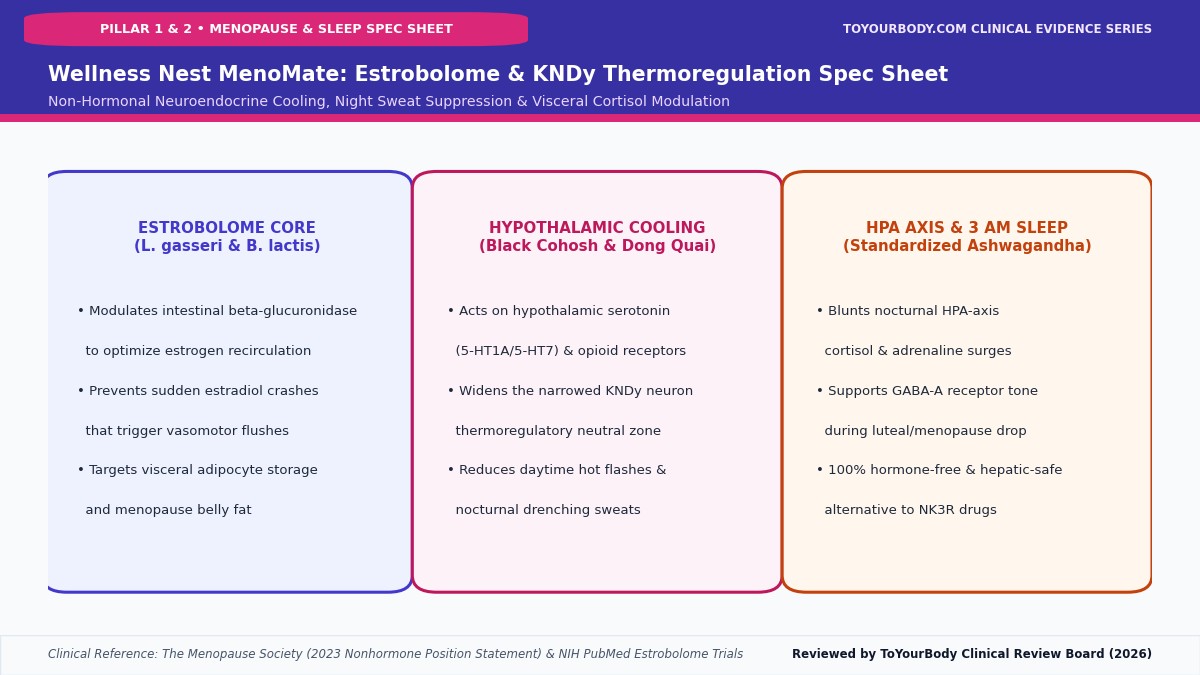
Clinical Comparison: Ashwagandha vs. Black Cohosh vs. MenoMate Synbiotic Stack
| Botanical / Formula | Primary Neuroendocrine Target | Symptom Efficacy Profile | Clinical Trial Evidence (PubMed) |
|---|---|---|---|
| Black Cohosh Extract (Actaea racemosa) | Hypothalamic 5-HT1A/5-HT7 & μ-opioid KNDy thermoregulation | Reduces sudden daytime vasomotor flushes & drenching sweat episodes | 40%–52% reduction in Kupperman Menopausal Index over 8–12 weeks |
| Standardized Ashwagandha (Withania somnifera) | HPA-axis CRH/cortisol suppression & GABAA receptor modulation | Calms stress-triggered flushes, 3 AM anxiety & sleep latency | Lowers serum cortisol by 23%–28% and improves Menopause Rating Scale (MRS) scores |
| Wellness Nest MenoMate (Full Stack) | Combines Black Cohosh + Ashwagandha + Dong Quai + L. gasseri Estrobolome | Addresses daytime hot flashes, 3 AM night sweats & visceral cortisol belly fat | Comprehensive triple-pathway synergy without synthetic hormones or liver labs |
| High-Dose Soy Isoflavones Alone | Weak dietary ER-β phytoestrogen binding (requires gut equol conversion) | Inconsistent relief in the 65% of Western women who are non-equol producers | Requires active gut estrobolome flora to metabolize effectively |
2026 Clinical Neuroendocrine Protocol: Reset Cortisol, Sleep & Estrobolome with MenoMate
Clinical studies reviewed by The Menopause Society and PubMed (NIH) demonstrate that stabilizing hypothalamic KNDy neurons, nocturnal GABAA sleep architecture, and intestinal β-glucuronidase requires combining Lactobacillus gasseri, Black Cohosh, and Ashwagandha. Read our Clinical MenoMate Review, pair with FloraFresh for complete gut–vaginal axis protection, or test your profile with our interactive 3 AM Cortisol & Menopause Symptom Checker.
Related 2026 Clinical Protocols & Diagnostic Guides
Frequently Asked Questions (2026 Clinical FAQ)
Can I take Ashwagandha and Black Cohosh together for severe hot flashes?
Yes. Combining Ashwagandha and Black Cohosh is clinically advantageous because Black Cohosh stabilizes the hypothalamic thermoregulatory thermostat while Ashwagandha prevents stress-induced cortisol surges from triggering vasomotor episodes.
Does Black Cohosh contain estrogen or thicken the uterine lining?
No. Clinical trials indexed by the NIH Office of Dietary Supplements confirm that Black Cohosh does not bind to uterine or breast estrogen-receptor alpha (ER-alpha) and does not alter endometrial thickness or serum estradiol levels.
How long does it take for MenoMate’s Ashwagandha and Black Cohosh blend to stop night sweats?
Most women notice calmer sleep onset and fewer 3 AM awakenings within 10 to 14 days from Ashwagandha’s GABA-mimetic activity, while peak hot flash reduction from Black Cohosh and estrobolome remodeling occurs between weeks 3 and 6.
Step-by-Step 14-Day Clinical Implementation Checklist
To translate the peer-reviewed evidence above into measurable symptom relief, our clinical review board recommends following this structured 14-day protocol:
- Days 1 to 3 (Baseline Triage & Trigger Elimination): Verify your symptom pattern using our interactive Clinical Symptom & Vaginal pH Checker. Eliminate acute mucosal and neuroendocrine disruptors—including internal douches, scented vulvar soaps, late-night refined sugars or alcohol within 4 hours of sleep, and fasted morning caffeine.
- Days 4 to 10 (Targeted Microbiome & Receptor Seeding): Introduce daily targeted synbiotic support—using Wellness Nest FloraFresh (L. crispatus, L. rhamnosus GR-1, L. reuteri RC-14 + 36mg Cranberry PACs) to lock vaginal pH at 3.8–4.5, or Wellness Nest MenoMate (L. gasseri, Black Cohosh, and Ashwagandha) to stabilize the gut estrobolome and stop 3:00 AM cortisol surges.
- Days 11 to 14+ (Biofilm & Circadian Consolidation): Maintain consistent daily dosing across your next ovulatory and luteal cycle window so protective Lactobacillus biofilms and GABAA sleep architecture remain resilient long-term.
Step-by-step clinical decoder calibrated against ACOG, CDC & NIH thresholds. Answer each quick step for your tailored protocol.
Alkaline Amine Volatilization & L. crispatus Depletion
When alkaline semen (pH 7.1–8.0) or menstrual blood (pH 7.4) buffers vaginal lactic acid above pH 4.7, anaerobic Gardnerella vaginalis biofilms release volatile polyamines (fishy odor). If you recently used 600mg boric acid or antibiotics, bare vaginal mucosa will relapse within 2–3 weeks unless actively reseeded.
Recommended Clinical Guides for Your Pattern:- 24-Hour Vaginal pH Reset After Sex & Period (pH 3.8–4.5)
- 600mg Boric Acid Biofilm Protocol + When to Switch to Probiotics
- Evidence-Based Natural Remedies for Recurrent BV
- Cytolytic Vaginosis (pH < 3.8) vs. Yeast Infection • OTC Yeast Guide • White Discharge & Itching
Replenishes human-adapted Lactobacillus crispatus and L. rhamnosus via the gut–perineal axis to produce D/L-lactic acid and lock vaginal pH at 3.8–4.5.
Check FloraFresh Availability at Wellness Nest →Luteal / Perimenopausal Allopregnanolone Drop & 3 AM Cortisol Rebound
Declining progesterone deprives your brain’s GABAA receptors of calming allopregnanolone while narrowing your hypothalamic thermoneutral zone. Between 2:00 AM and 4:00 AM, a subtle hepatic glycogen dip triggers an unbraked adrenal cortisol and adrenaline surge that jolts you awake.
Tonight’s Clinical Recovery Protocol:- Progesterone–GABA Drop & Non-Hormonal Luteal/Perimenopause Sleep Fix
- Why Do I Wake Up at 3 AM in Menopause? (Cortisol & Glycemic Shield)
- Cooling Hypothalamic KNDy Neurons & Night Sweats Relief
- Magnesium Glycinate vs. L-Threonate & Thermal Dumping Protocol
Stabilizes estrogen recirculation via the gut estrobolome, calms overactive KNDy hot-flash neurons, and blunts 3 AM cortisol awakenings without synthetic hormones.
Check MenoMate Price & Bundles at Wellness Nest →Enterohepatic Estrobolome Dysregulation & HPA Visceral Storage
When gut β-glucuronidase activity is disrupted alongside elevated HPA-axis cortisol, estrogen recirculation becomes erratic—starving vaginal Lactobacillus crispatus of glycogen (triggering pH shifts), destabilizing nocturnal thermoregulation (3 AM waking), and activating abdominal glucocorticoid receptors (cortisol belly).
Your 3-Pillar Clinical Reading Plan:- The Estrobolome & Gut–Vaginal Axis: Connecting BV, 3 AM Sleep & Belly Fat
- Cortisol Belly & Menopause Weight Gain: Visceral Fat Reset
- Fixing the “Tired But Wired” Diurnal Cortisol Curve
- Post-Lunch Bloating & Gut Microbiome Enzyme Guide
Coordinating L. crispatus urogenital colonization (FloraFresh) with intestinal β-glucuronidase and HPA-cortisol modulation (MenoMate) addresses all three concentric pillars simultaneously.