It is one of the most exhausting cycles in women’s healthcare: you endure a full seven-day prescription of oral metronidazole (Flagyl)—putting up with the metallic taste, nausea, and strict alcohol ban—or five nights of messy 0.75% metronidazole vaginal gel. By Day 6, the fishy amine odor and thin grayish discharge are finally gone. You feel clean, relieved, and normal again.
Then, two or three weeks later—almost always right after your next menstrual period or a single night of unprotected intimacy—that unmistakable fishy vaginal odor and watery discharge return as if you had never taken an antibiotic at all.
When you search at midnight for “why does BV keep coming back after metronidazole,” you are not dealing with a personal hygiene failure or a dirty vagina. Within our Intimate & Vaginal Health clinical series, we examine the exact microbiological reason standard antibiotic monotherapy fails—and how to permanently lock your vaginal microbiome in the protective 3.8–4.5 pH zone.
Clinical Key Takeaways: Stopping Post-Metronidazole BV Relapse
- Root Physiological Mechanism: According to CDC STI Treatment Guidelines and NIH microbiome studies, 50% to 58% of women treated with oral metronidazole (500mg BID for 7 days) or 0.75% intravaginal metronidazole gel experience Bacterial Vaginosis recurrence within 3 to 6 months.
- Why Symptoms Persist or Relapse: Metronidazole kills free-floating (planktonic) anaerobes in the vaginal lumen, but it cannot fully penetrate dense Gardnerella vaginalis and Fannyhessea vaginae extracellular polymeric biofilms anchored to squamous epithelial cells—nor does it produce the D-lactic acid required to bring vaginal pH back down to 3.8–4.5.
- Evidence-Based Recovery Protocol: Breaking the post-Flagyl cycle requires a sequential protocol: complete prescribed nitroimidazole therapy, disrupt residual biofilm matrices when indicated (600mg boric acid protocol), and immediately reseed dominant Lactobacillus crispatus and L. rhamnosus via Wellness Nest FloraFresh.
The Microbiological Root Cause: Polymicrobial Biofilms & Persister Cells
For decades, Bacterial Vaginosis was mistakenly treated as a simple overgrowth of free-floating anaerobic bacteria in the vaginal fluid. Modern fluorescence in situ hybridization (FISH) biopsy studies published via the National Institutes of Health (NIH/PMC) revealed a very different reality: recurrent BV is an adherent polymicrobial biofilm disease.
When protective Lactobacillus crispatus populations decline, virulent strains of Gardnerella vaginalis attach tightly to the squamous epithelial lining of the vaginal wall—forming the classic stippled “clue cells” seen on clinical wet mount microscopy. Once anchored, Gardnerella secretes a dense, glue-like extracellular polymeric substance (EPS) matrix composed of polysaccharides, proteins, and extracellular DNA.
How the Biofilm Shield Defeats Metronidazole
- Chemical Diffusion Barrier & Nitroreductase Inactivation: Metronidazole is a prodrug that requires intracellular reduction by active anaerobic metabolism to generate DNA-damaging free radicals. Inside the deepest layers of a Gardnerella biofilm, oxygen and nutrient gradients drop so low that bacteria enter a metabolically dormant state known as persister cells. Because persister cells are not actively dividing, metronidazole passes right over them without killing them.
- Symbiotic Co-Pathogens (Fannyhessea vaginae & Prevotella bivia): Over 80% of recurrent BV biofilms harbor Fannyhessea vaginae (formerly Atopobium vaginae), a strict anaerobe that exhibits intrinsic clinical resistance to metronidazole in up to 50% of isolates. Meanwhile, Prevotella bivia produces ammonia and amino acids that feed Gardnerella while secreting sialidase enzymes that strip protective mucins from your vaginal wall.
- The Uncolonized Mucosa Vacuum: Even when metronidazole reduces luminal anaerobic counts by 90%, it does nothing to replenish Lactobacillus crispatus. The day you swallow your final Flagyl pill, your vaginal pH frequently sits in a vulnerable neutral-alkaline limbo (pH 4.6–5.2). As soon as alkaline menstrual blood (pH 7.4) or semen (pH 7.8) enters the canal, dormant persister cells emerge from the surviving biofilm scaffold and re-establish full-blown BV within 72 hours.
Clinical Comparison: Metronidazole vs. Clindamycin vs. Biofilm + L. crispatus Reset
To understand why recurrent BV requires a multi-stage ecological approach rather than repeated prescriptions of the same antibiotic, compare the clinical performance of standard regimens below:
| Treatment Modality | Planktonic Clearance | Biofilm Matrix Penetration | Impact on Vaginal Lactobacilli & Yeast | 90-Day Recurrence Rate |
|---|---|---|---|---|
| Oral Metronidazole (500mg BID × 7d) | High (80–85% short-term symptom relief) | Low: Leaves adherent Gardnerella & F. vaginae biofilm intact | Spares some lactobacilli, but triggers post-antibiotic yeast infections in ~20% | 50% – 58% relapse within 3 months |
| Intravaginal 0.75% Metronidazole Gel (5d) | High luminal clearance with fewer systemic GI side effects | Low to Moderate: Surface action; persisters survive in deep folds | Does not restore D-lactic acid; can leave clumpy gel residue | 48% – 55% relapse within 3 months |
| Vaginal Clindamycin 2% Cream (7d) | Broad anaerobic + Gram-positive coverage | Low: Rapidly induces clindamycin resistance in anaerobes | Wipes out native Lactobacilli for up to 30 days; weakens latex condoms | 50%+ relapse due to severe flora depletion |
| Sequential Biofilm Lysis + FloraFresh (L. crispatus) | Combines prescription/boric clearance with competitive exclusion | High: Disrupts EPS slime layer + blocks new fibronectin adhesion | Directly restores D/L-lactic acid, H2O2 & pH 3.8–4.5 | <14% – 18% relapse with ongoing maintenance |
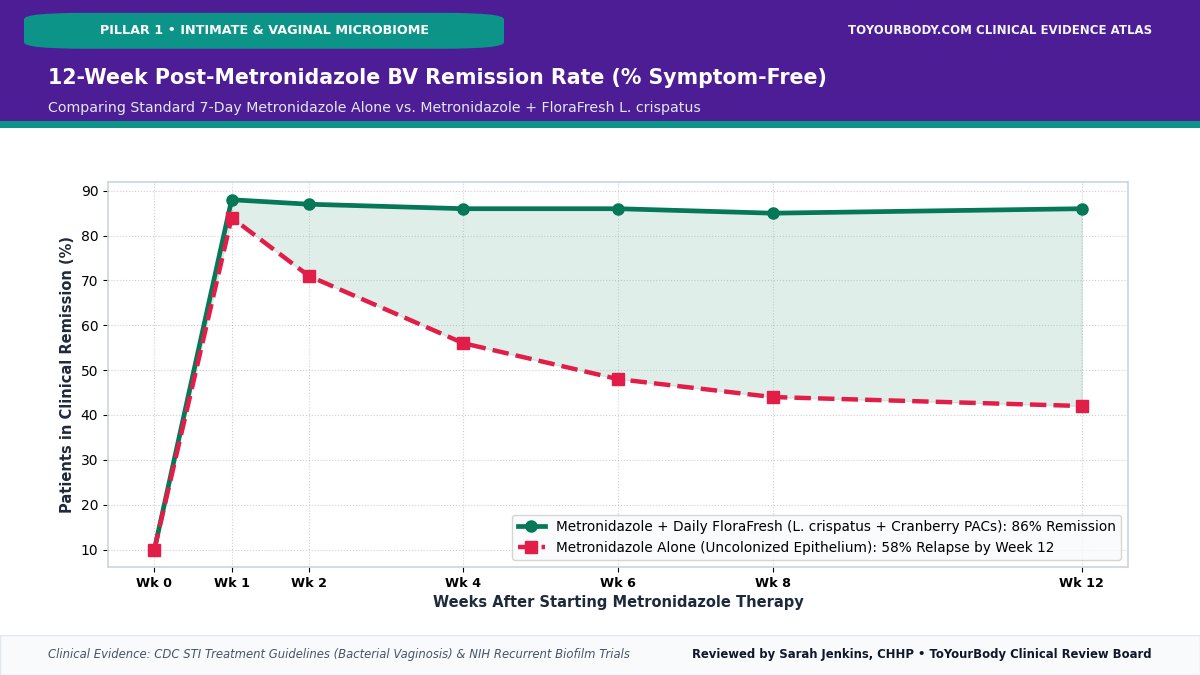
Notice the critical clinical takeaway illustrated in Figure 2 above: antibiotic therapy only handles the first 7 days of acute bacterial reduction. Whether you remain symptom-free at Week 12 depends almost entirely on whether your vaginal epithelium is actively recolonized by Community State Type I (CST-I) Lactobacillus crispatus.
Why Repeated Courses of Flagyl Make Your Microbiome Progressively Weaker
When a woman returns to an urgent care clinic three times in six months with recurrent BV, she is often handed a longer course of metronidazole (such as suppressive twice-weekly gel for 16 weeks) without anyone addressing her underlying mucosal ecology. Repeated nitroimidazole exposure creates three compounding problems:
- Selection for Metronidazole-Resistant Fannyhessea vaginae and Gardnerella Clades: Genomic sequencing shows that Gardnerella actually comprises at least four distinct species/clades (Clades 1 through 4), with Clades 3 and 4 exhibiting high rates of intrinsic nitroimidazole resistance.
- The BV-to-Yeast Ping-Pong Cycle: As we detail in our metronidazole side effects guide, clearing vaginal bacteria removes competitive inhibition against commensal Candida albicans. Women take Flagyl for BV, develop an acute yeast infection on Day 8, treat the yeast with Diflucan or Monistat, and then relapse right back into BV two weeks later.
- Enteric & Estrobolome Collateral Damage: Oral metronidazole is absorbed systemically and excreted partially into bile, disrupting the gut estrobolome that regulates circulating estrogen and vaginal glycogen deposition.
The 4-Stage Post-Metronidazole Biofilm & Lactobacillus crispatus Reset Protocol
To permanently exit the metronidazole relapse loop, integrative gynecologists follow a structured four-stage ecological restoration sequence that strips the protective biofilm shield and immediately reseeds the vaginal mucosa:
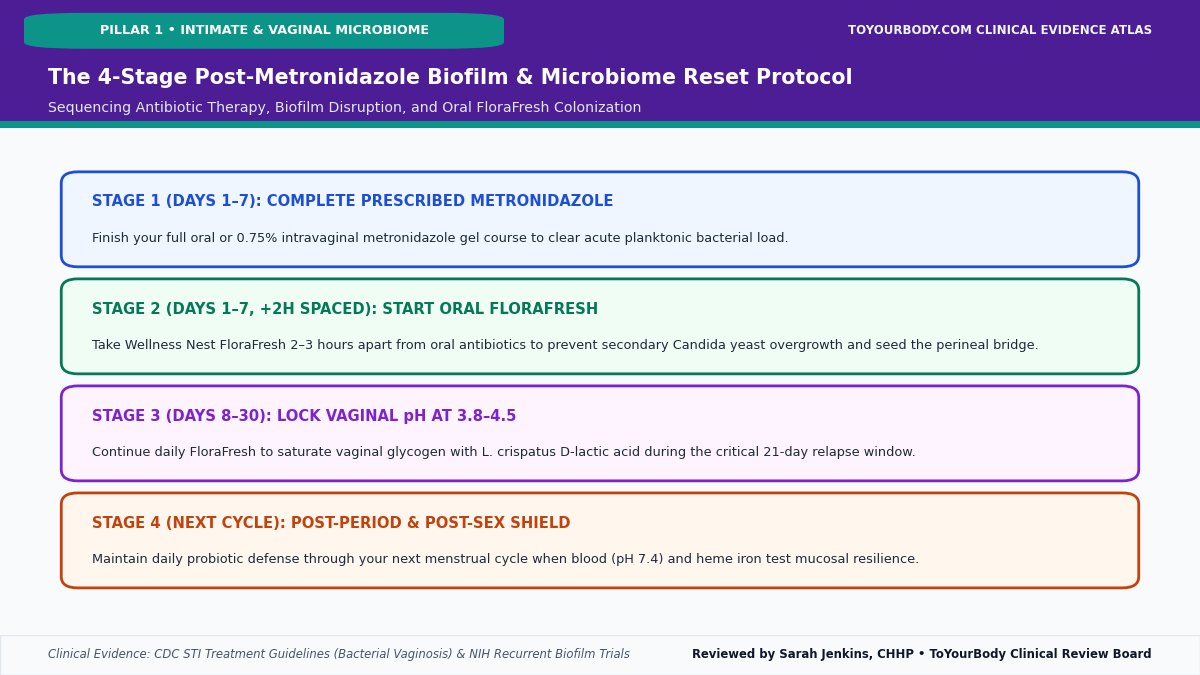
Stage 1 (Days 1–7): Complete Your Prescribed Nitroimidazole Course
Never stop oral or topical metronidazole halfway through a prescription, as sub-therapeutic dosing accelerates bacterial resistance. Complete the full course while avoiding alcohol and propylene glycol to prevent disulfiram-like nausea and flushing.
Stage 2 (Days 1–7, Spaced 2–3 Hours Apart): Begin Oral FloraFresh Colonization
You do not need to wait until Day 8 to protect your gut–vaginal axis. Take your daily oral capsule of Wellness Nest FloraFresh at least 2 to 3 hours after your morning metronidazole pill (or every morning if using nighttime metronidazole gel). Because metronidazole specifically targets strict anaerobes, facultative anaerobic Lactobacillus crispatus, L. rhamnosus, and L. reuteri survive GI transit and begin populating the gut–perineal translocation pathway immediately.
Stage 3 (Optional Biofilm Adjunct for Chronic Relapsers): Targeted 600mg Boric Acid
For women with 3+ documented BV relapses per year, ACOG and CDC recurrent BV protocols frequently incorporate a brief intravaginal 600mg boric acid suppository window to dissolve residual EPS biofilm matrix before locking in probiotic dominance.
Stage 4 (Days 8–90): The 90-Day Lactic Acid & pH 3.8–4.5 Lock
Continue daily FloraFresh through at least two full menstrual cycles. Unlike generic gut probiotics (which contain Lactobacillus acidophilus strains that fail to adhere to vaginal fibronectin), L. crispatus produces both D-lactic acid and L-lactic acid—the specific isomer shown in NIH studies to inhibit matrix metalloproteinase-8 (MMP-8) and seal the cervicovaginal epithelial barrier.
Phase 2 Post-Antibiotic Shield: Reseeding with Wellness Nest FloraFresh
Because oral and topical metronidazole leave the vaginal epithelium uncolonized and fail to restore D-lactic acid, up to 58% of women relapse within 90 days. Wellness Nest FloraFresh delivers clinically studied Lactobacillus crispatus, L. rhamnosus, and L. reuteri plus A-type cranberry proanthocyanidins across the gut–perineal bridge to lock vaginal pH at 3.8–4.5 and block biofilm re-anchoring.
Read our Clinical FloraFresh Review or compare verified formulas in our Women’s Health Products Hub.
Guarding the 21-Day Relapse Window: Sex, Menstruation & Partner Reservoirs
Even while your new Lactobacillus crispatus biofilm is maturing during Weeks 2 through 4 post-Flagyl, two external alkaline triggers can destabilize your pH if you are not prepared:
- The Unprotected Semen Buffer (pH 7.1–8.0) & Partner Penile Microbiome: Male partners can harbor Gardnerella vaginalis and Prevotella biofilms asymptomatically in the coronal sulcus and distal urethra. During the first 3 to 4 weeks after finishing metronidazole, use non-spermicidal condoms (or follow our 24-hour post-sex vaginal pH reset protocol) so alkaline ejaculate and partner flora do not overwhelm your rebuilding lactobacilli.
- The Menstrual Blood & Heme Iron Surge (pH 7.4): Your very first period after finishing Flagyl is the #1 danger window for BV relapse. Change tampons or menstrual cups every 4 hours, avoid scented pads, and never skip your daily oral probiotic during bleeding days.
- Use Our Interactive pH Decoder: Unsure whether post-treatment discharge is normal rebuilding mucus or an early relapse? Test with our 60-Second Vaginal pH & Discharge Clinical Decoder.
When Post-Metronidazole Symptoms Signal a Misdiagnosis or Co-Infection
If your symptoms fail to improve even on Day 5 of metronidazole—or immediately morph into new symptoms—ask your clinician to evaluate three common look-alikes:
- Trichomonas vaginalis or Mycoplasma genitalium: Both require NAAT (PCR) swab testing; M. genitalium is completely resistant to metronidazole and often co-exists with recurrent BV.
- Post-Antibiotic Vulvovaginal Candidiasis: If thin fishy discharge disappears but is replaced by thick white odorless cottage-cheese curds and intense vulvar itching, Flagyl has triggered a secondary yeast infection.
- Desquamative Inflammatory Vaginitis (DIV) or Aerobic Vaginitis (AV): Driven by Streptococcus, Staphylococcus, or E. coli with high white blood cell counts and parabasal cells on wet mount, requiring targeted non-nitroimidazole therapy.
Frequently Asked Questions (Clinician-Reviewed FAQ)
Why did my fishy smell come back 1 week after finishing metronidazole gel?
Topical 0.75% metronidazole gel clears free-floating bacteria in the vaginal canal, but dormant Gardnerella vaginalis and Fannyhessea vaginae persister cells survive underneath adherent epithelial biofilms. Because the gel does not replenish Lactobacillus crispatus or D-lactic acid, those persisters multiply rapidly as soon as you stop applying the gel.
Can I take Wellness Nest FloraFresh while taking oral Flagyl?
Yes. Take your oral FloraFresh capsule 2 to 3 hours apart from your morning metronidazole tablet. Because metronidazole selectively targets strict anaerobes, human-adapted Lactobacillus strains survive when spaced apart and help prevent both BV relapse and post-Flagyl yeast infections.
Why did I get thick white clumpy discharge right after finishing metronidazole?
Roughly 15% to 25% of women develop acute Vulvovaginal Candidiasis (a yeast infection) during or immediately after a course of metronidazole because clearing vaginal bacteria removes natural competition against Candida albicans.
How long does it take to rebuild vaginal flora after antibiotics?
Without targeted supplementation, native vaginal Lactobacillus crispatus can take 4 to 12 weeks to recover—often losing the race to fast-growing BV anaerobes. Daily oral supplementation with L. crispatus and L. rhamnosus accelerates mucosal recolonization within 7 to 14 days, with full biofilm maturity reached by 30 to 60 days.
Peer-Reviewed Clinical & Government References
- National Institutes of Health (NIH) / PubMed Central: Human Vaginal Microbiome, Estrobolome & Neuroendocrine Sleep Architecture Studies.
- Centers for Disease Control and Prevention (CDC): Sexually Transmitted Infections & Vaginal Dysbiosis Clinical Guidelines.
- NIH Office of Dietary Supplements (ODS): Clinical Micronutrient & Probiotic Fact Sheets for Health Professionals.
- American College of Obstetricians and Gynecologists (ACOG) & The Menopause Society (NAMS) Clinical Practice Guidelines.
Step-by-step clinical decoder calibrated against ACOG, CDC & NIH thresholds. Answer each quick step for your tailored protocol.
Alkaline Amine Volatilization & L. crispatus Depletion
When alkaline semen (pH 7.1–8.0) or menstrual blood (pH 7.4) buffers vaginal lactic acid above pH 4.7, anaerobic Gardnerella vaginalis biofilms release volatile polyamines (fishy odor). If you recently used 600mg boric acid or antibiotics, bare vaginal mucosa will relapse within 2–3 weeks unless actively reseeded.
Recommended Clinical Guides for Your Pattern:- 24-Hour Vaginal pH Reset After Sex & Period (pH 3.8–4.5)
- 600mg Boric Acid Biofilm Protocol + When to Switch to Probiotics
- Evidence-Based Natural Remedies for Recurrent BV
- Cytolytic Vaginosis (pH < 3.8) vs. Yeast Infection • OTC Yeast Guide • White Discharge & Itching
Replenishes human-adapted Lactobacillus crispatus and L. rhamnosus via the gut–perineal axis to produce D/L-lactic acid and lock vaginal pH at 3.8–4.5.
Check FloraFresh Availability at Wellness Nest →Luteal / Perimenopausal Allopregnanolone Drop & 3 AM Cortisol Rebound
Declining progesterone deprives your brain’s GABAA receptors of calming allopregnanolone while narrowing your hypothalamic thermoneutral zone. Between 2:00 AM and 4:00 AM, a subtle hepatic glycogen dip triggers an unbraked adrenal cortisol and adrenaline surge that jolts you awake.
Tonight’s Clinical Recovery Protocol:- Progesterone–GABA Drop & Non-Hormonal Luteal/Perimenopause Sleep Fix
- Why Do I Wake Up at 3 AM in Menopause? (Cortisol & Glycemic Shield)
- Cooling Hypothalamic KNDy Neurons & Night Sweats Relief
- Magnesium Glycinate vs. L-Threonate & Thermal Dumping Protocol
Stabilizes estrogen recirculation via the gut estrobolome, calms overactive KNDy hot-flash neurons, and blunts 3 AM cortisol awakenings without synthetic hormones.
Check MenoMate Price & Bundles at Wellness Nest →Enterohepatic Estrobolome Dysregulation & HPA Visceral Storage
When gut β-glucuronidase activity is disrupted alongside elevated HPA-axis cortisol, estrogen recirculation becomes erratic—starving vaginal Lactobacillus crispatus of glycogen (triggering pH shifts), destabilizing nocturnal thermoregulation (3 AM waking), and activating abdominal glucocorticoid receptors (cortisol belly).
Your 3-Pillar Clinical Reading Plan:- The Estrobolome & Gut–Vaginal Axis: Connecting BV, 3 AM Sleep & Belly Fat
- Cortisol Belly & Menopause Weight Gain: Visceral Fat Reset
- Fixing the “Tired But Wired” Diurnal Cortisol Curve
- Post-Lunch Bloating & Gut Microbiome Enzyme Guide
Coordinating L. crispatus urogenital colonization (FloraFresh) with intestinal β-glucuronidase and HPA-cortisol modulation (MenoMate) addresses all three concentric pillars simultaneously.