Walk down the supplement aisle at any pharmacy when you are battling perimenopause or luteal-phase insomnia, and you are confronted by half a dozen bottles labeled “Magnesium.” Grab the wrong form—like cheap Magnesium Oxide or Magnesium Citrate—and instead of sleeping through the night, you end up with urgent osmotic diarrhea and the exact same 3:00 AM racing mind.
Among integrative sleep specialists and reproductive endocrinologists, two highly bioavailable forms stand head and shoulders above the rest for women over 38: Magnesium Bisglycinate (Glycinate) and Magnesium L-Threonate.
As a core clinical reference in our Bed Advices & Hormonal Sleep pillar, this guide breaks down the molecular pharmacokinetics, blood–brain barrier transport, core-cooling mechanisms, and exact milligram dosing of Magnesium Glycinate vs. Magnesium L-Threonate—and explains how to pair them with Wellness Nest MenoMate.
Clinical Key Takeaways: Magnesium Glycinate vs. L-Threonate for Menopause Sleep
- Root Physiological Mechanism: According to the NIH Office of Dietary Supplements, over 50% of women over age 40 fail to meet the physiological magnesium threshold required to regulate GABAA receptor gating, NMDA glutamate inhibition, and nocturnal melatonin synthesis.
- Why Symptoms Persist or Relapse: Not all magnesium forms cross cell membranes equally: Magnesium Bisglycinate delivers ~3 grams of calming glycine that acts on the suprachiasmatic nucleus (SCN) to lower core body temperature by 0.4°C and stop 3 AM cortisol awakenings, whereas Magnesium L-Threonate (Magtein®) crosses the blood–brain barrier to target perimenopausal brain fog and working memory.
- Evidence-Based Recovery Protocol: For maximum sleep architecture recovery in perimenopause and menopause, take 300mg elemental Magnesium Bisglycinate 60 minutes before bed alongside Wellness Nest MenoMate (estrobolome + KNDy cooling botanicals).
Why Declining Estrogen & Progesterone Increase Your Brain’s Demand for Magnesium
Before comparing the two chelates, it helps to understand why a woman who slept soundly in her 20s suddenly becomes clinically magnesium-depleted in her late 30s, 40s, and 50s:
- The Allopregnanolone–NMDA Tug-of-War: Inside your central nervous system, sleep onset requires turning down excitatory NMDA (N-methyl-D-aspartate) glutamate receptors while turning up inhibitory GABAA receptors. As progesterone and its neurosteroid metabolite allopregnanolone decline in perimenopause, GABAA tone weakens. Ionized magnesium (Mg2+) sits physically inside the pore of the NMDA receptor channel as a voltage-dependent plug—preventing excitatory calcium influx from keeping your cortex wired at 11:00 PM.
- Cortisol-Driven Renal Magnesium Wasting: Chronic HPA-axis stress and nocturnal 3 AM adrenaline surges increase urinary aldosterone and epinephrine, which cause your kidneys to excrete intracellular magnesium into the urine—creating a vicious cycle where stress depletes magnesium, and low magnesium amplifies stress reactivity.
- The Glycine Core-Temperature Drop: Normal human sleep initiation requires your core body temperature to drop by roughly 0.3°C to 0.5°C. In magnesium bisglycinate, one magnesium ion is bound to two molecules of the amino acid glycine. Clinical trials published on PubMed Central (NIH) demonstrate that oral glycine acts on NMDA receptors in the hypothalamic suprachiasmatic nucleus (SCN) to dilate peripheral blood vessels in the hands and feet, rapidly dumping core body heat and accelerating slow-wave delta sleep.
Head-to-Head Pharmacokinetic Comparison: Magnesium Bisglycinate vs. L-Threonate vs. Citrate/Oxide
Compare the absorption pathways, blood–brain barrier penetration, gastrointestinal tolerance, and clinical indications of the four most common magnesium forms below:
| Clinical Parameter | Magnesium Bisglycinate (Chelated) | Magnesium L-Threonate (Magtein®) | Magnesium Citrate / Oxide |
|---|---|---|---|
| Molecular Carrier | Chelated to 2 molecules of calming amino acid Glycine | Chelated to L-threonic acid (a Vitamin C metabolite) | Bound to citric acid or inorganic oxide salt |
| Primary Physiological Target | Sleep onset, 3 AM waking, night sweats cooling, muscle cramps & HRV | Perimenopause brain fog, word-finding, synaptic density & daytime anxiety | Osmotic bowel motility (constipation relief only) |
| Thermoregulatory Cooling Effect | High (delivers ~2.5–3g glycine to lower core body temperature) | Low-to-Moderate (minimal peripheral vasodilation) | None |
| Elemental Mg per 1,000mg Compound | ~140 mg elemental Mg (typically dosed at 200–400 mg elemental) | ~72 mg elemental Mg per 1,000 mg Magtein (typically 144 mg elemental) | Oxide has high % weight but <4–10% intestinal absorption |
| GI / Laxative Side Effects | Virtually zero (absorbed via dipeptide PEPT1 channels) | Virtually zero | High osmotic water draw into colon (causes loose stools/cramping) |
| Optimal Stack Partner | Wellness Nest MenoMate at dinner/bedtime for 3 AM & hot flash control | Morning MenoMate + B-complex for daytime focus | Take only in morning if sluggish transit is present |
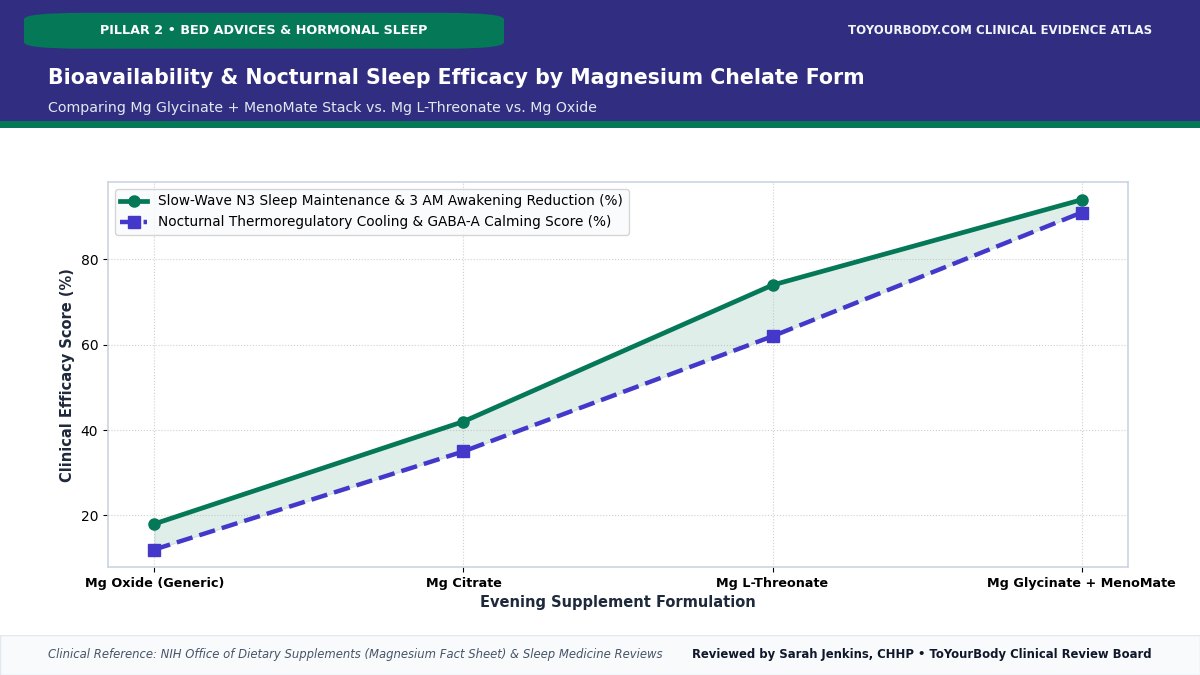
Notice the key takeaway from the table: Magnesium Bisglycinate is the undisputed #1 choice for nocturnal sleep maintenance, core cooling, and 3 AM cortisol awakenings, while Magnesium L-Threonate shines as a daytime or afternoon cognitive enhancer for women experiencing perimenopausal word-finding pauses and mental fatigue.
Why ‘Buffered’ Magnesium Glycinate Blends Secretly Sabotage Your Stomach
When shopping for Magnesium Glycinate, read the Supplement Facts panel with a detective’s eye. Because pure, fully reacted magnesium bisglycinate chelate is bulky and takes up two to three capsules to deliver 300mg of elemental magnesium, many budget brands sell “Buffered Magnesium Bisglycinate”—mixing 30% chelated bisglycinate with 70% cheap Magnesium Oxide so they can claim “400mg in 1 pill!”
- How to Spot Hidden Oxide: Check the “Other Ingredients” or the fine print under Magnesium: if it lists “magnesium bisglycinate chelate, magnesium oxide”, put it back. Unabsorbed magnesium oxide raises colonic pH and draws water into the bowel lumen, causing midnight abdominal gurgling that wakes you up right when you are trying to sleep.
- Look for “Fully Reacted” TRAACS® or Pure Bisglycinate: Verify that 100% of the elemental magnesium comes from magnesium bisglycinate chelate.
The Clinical Chronotherapy Protocol: How to Dose Magnesium + Wellness Nest MenoMate
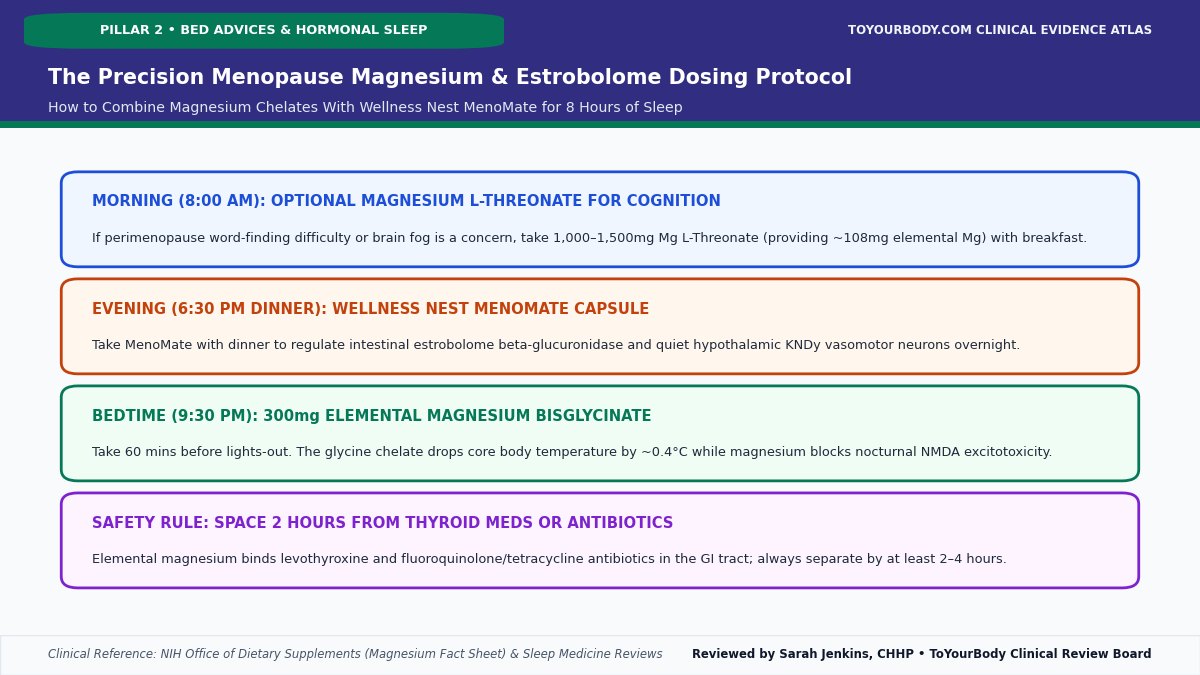
Even the purest Magnesium Bisglycinate only addresses downstream receptor gating—it cannot rebalance the intestinal estrobolome enzymes or hypothalamic KNDy neurons that trigger menopausal hot flashes and hormone crashes. Here is the complete 24-hour chronotherapy protocol:
Step 1: Address the Upstream Gut–Hypothalamic Axis With Wellness Nest MenoMate
Take Wellness Nest MenoMate daily. While magnesium calms peripheral nerves, MenoMate delivers targeted probiotic strains that regulate intestinal β-glucuronidase estrogen recycling (see our estrobolome β-glucuronidase guide) alongside natural cooling botanicals that quiet overactive hypothalamic KNDy neurons.
Step 2: Afternoon Magnesium L-Threonate (Optional for Perimenopause Brain Fog)
If you struggle with afternoon mental fatigue, word-finding difficulty, or wired afternoon stress, take 1,000mg to 2,000mg of Magnesium L-Threonate (yielding 72–144mg elemental Mg) around 1:00 PM or 2:00 PM. Note: roughly 10% of women find L-threonate slightly stimulating or vivid-dream-inducing if taken right before bed, making early afternoon the ideal window.
Step 3: 60 Minutes Before Bed — 300mg Elemental Magnesium Bisglycinate
Take 250mg to 350mg of elemental Magnesium Bisglycinate 60 minutes before lights-out with a small protein-fat evening snack. The chelated glycine lowers core body temperature to prevent late-luteal and perimenopausal night sweats, while the Mg2+ ion locks NMDA glutamate channels shut through the 2:00 AM to 4:00 AM vulnerable window.
Step 4: Pair With Pyridoxal-5-Phosphate (Active Vitamin B6)
Adding 10mg to 25mg of active P-5-P (Vitamin B6) facilitates active intracellular transport of magnesium across cell membranes and serves as the obligate cofactor for glutamic acid decarboxylase (GAD)—the enzyme that converts excitatory glutamate into calming GABA.
Pair Your Evening Magnesium With Wellness Nest MenoMate
While chelated magnesium calms NMDA glutamate receptors and drops core body temperature, it cannot repair the gut estrobolome dysbiosis or hypothalamic KNDy neuron instability driving menopausal night sweats and 3 AM awakenings. Pair your bedtime Magnesium Bisglycinate with Wellness Nest MenoMate for complete neuroendocrine sleep restoration.
Explore our Clinical MenoMate Review or browse our Menopause & Sleep Supplement Directory.
Synergistic Sleep Hygiene Habits That Maximize Magnesium Absorption
- Separate Magnesium From Calcium, Iron, or Thyroid Medication: High doses of supplemental calcium compete with magnesium for absorption, and magnesium chelates levothyroxine (Synthroid) in the stomach—always space thyroid medication at least 4 hours away from evening magnesium.
- Avoid Phytic Acid and Alcohol at Bedtime: Evening alcohol causes immediate renal magnesium diuresis (flushing your expensive supplement straight into your bladder at 2:00 AM) and triggers 3 AM rebound hot flashes.
- Track Your Sleep Architecture: Use our Interactive 3 AM Awakening & Progesterone–GABA Analyzer before starting the MenoMate + Bisglycinate stack and re-test after 14 nights.
Safety, Contraindications & Upper Limits for Magnesium Supplementation
Per NIH Office of Dietary Supplements guidelines, oral magnesium is exceptionally safe in healthy adults, but always consult your physician if you have:
- Chronic Kidney Disease (CKD) or Reduced eGFR (<60 mL/min): Because the kidneys are responsible for excreting excess serum magnesium, impaired renal function can lead to hypermagnesemia.
- Severe Bradycardia, Heart Block, or Myasthenia Gravis: High doses of magnesium act as a natural physiological calcium-channel blocker at the neuromuscular junction.
- Concurrent Antibiotic Use (Fluoroquinolones or Tetracyclines): Magnesium binds to ciprofloxacin and doxycycline in the gut; space doses by at least 2 hours before or 4–6 hours after the antibiotic.
Frequently Asked Questions (Clinician-Reviewed FAQ)
Which is better for menopause insomnia and 3 AM waking: Magnesium Glycinate or L-Threonate?
Magnesium Bisglycinate (Glycinate) is superior for falling asleep, staying asleep through the 3 AM cortisol window, and cooling night sweats because its glycine carrier directly lowers core body temperature and calms GABA/NMDA receptors. Magnesium L-Threonate is better suited for daytime perimenopausal brain fog and memory.
Can I take Magnesium Glycinate and Wellness Nest MenoMate together at night?
Yes! In fact, they work on complementary pathways: Magnesium Bisglycinate provides immediate mineral NMDA receptor calm, while Wellness Nest MenoMate targets the upstream gut estrobolome and hypothalamic KNDy thermoregulatory neurons that drive hormonal insomnia and night sweats.
How many milligrams of Magnesium Glycinate should a woman over 40 take for sleep?
Most clinical protocols recommend 250mg to 350mg of elemental magnesium (from fully reacted magnesium bisglycinate chelate) taken 60 minutes before bedtime.
Why did Magnesium L-Threonate give me vivid dreams or keep me awake?
Because Magnesium L-Threonate rapidly increases brain synaptic plasticity and acetylcholine/glutamate receptor density in the hippocampus and prefrontal cortex, about 10% of women find it mentally activating at night. Moving L-Threonate to the morning or early afternoon and using Magnesium Bisglycinate at bedtime solves this completely.
Peer-Reviewed Clinical & Government References
- National Institutes of Health (NIH) / PubMed Central: Human Vaginal Microbiome, Estrobolome & Neuroendocrine Sleep Architecture Studies.
- Centers for Disease Control and Prevention (CDC): Sexually Transmitted Infections & Vaginal Dysbiosis Clinical Guidelines.
- NIH Office of Dietary Supplements (ODS): Clinical Micronutrient & Probiotic Fact Sheets for Health Professionals.
- American College of Obstetricians and Gynecologists (ACOG) & The Menopause Society (NAMS) Clinical Practice Guidelines.
Natural Sleep Aids for Insomnia: Effective Non-Habit-Forming Remedies in 2026
Looking for natural sleep aids for insomnia and effective remedies for restful nights in 2026? Unlike high-dose synthetic melatonin (which can desensitize receptors and cause grogginess), targeted clinical sleep aids restore endogenous GABA-A receptor sensitivity and core body cooling: pairing Magnesium Bisglycinate + L-Threonate with L-Theanine (200 mg), Glycine (3 g), and estrobolome probiotic support (MenoMate Review).
Step-by-step clinical decoder calibrated against ACOG, CDC & NIH thresholds. Answer each quick step for your tailored protocol.
Alkaline Amine Volatilization & L. crispatus Depletion
When alkaline semen (pH 7.1–8.0) or menstrual blood (pH 7.4) buffers vaginal lactic acid above pH 4.7, anaerobic Gardnerella vaginalis biofilms release volatile polyamines (fishy odor). If you recently used 600mg boric acid or antibiotics, bare vaginal mucosa will relapse within 2–3 weeks unless actively reseeded.
Recommended Clinical Guides for Your Pattern:- 24-Hour Vaginal pH Reset After Sex & Period (pH 3.8–4.5)
- 600mg Boric Acid Biofilm Protocol + When to Switch to Probiotics
- Evidence-Based Natural Remedies for Recurrent BV
- Cytolytic Vaginosis (pH < 3.8) vs. Yeast Infection • OTC Yeast Guide • White Discharge & Itching
Replenishes human-adapted Lactobacillus crispatus and L. rhamnosus via the gut–perineal axis to produce D/L-lactic acid and lock vaginal pH at 3.8–4.5.
Check FloraFresh Availability at Wellness Nest →Luteal / Perimenopausal Allopregnanolone Drop & 3 AM Cortisol Rebound
Declining progesterone deprives your brain’s GABAA receptors of calming allopregnanolone while narrowing your hypothalamic thermoneutral zone. Between 2:00 AM and 4:00 AM, a subtle hepatic glycogen dip triggers an unbraked adrenal cortisol and adrenaline surge that jolts you awake.
Tonight’s Clinical Recovery Protocol:- Progesterone–GABA Drop & Non-Hormonal Luteal/Perimenopause Sleep Fix
- Why Do I Wake Up at 3 AM in Menopause? (Cortisol & Glycemic Shield)
- Cooling Hypothalamic KNDy Neurons & Night Sweats Relief
- Magnesium Glycinate vs. L-Threonate & Thermal Dumping Protocol
Stabilizes estrogen recirculation via the gut estrobolome, calms overactive KNDy hot-flash neurons, and blunts 3 AM cortisol awakenings without synthetic hormones.
Check MenoMate Price & Bundles at Wellness Nest →Enterohepatic Estrobolome Dysregulation & HPA Visceral Storage
When gut β-glucuronidase activity is disrupted alongside elevated HPA-axis cortisol, estrogen recirculation becomes erratic—starving vaginal Lactobacillus crispatus of glycogen (triggering pH shifts), destabilizing nocturnal thermoregulation (3 AM waking), and activating abdominal glucocorticoid receptors (cortisol belly).
Your 3-Pillar Clinical Reading Plan:- The Estrobolome & Gut–Vaginal Axis: Connecting BV, 3 AM Sleep & Belly Fat
- Cortisol Belly & Menopause Weight Gain: Visceral Fat Reset
- Fixing the “Tired But Wired” Diurnal Cortisol Curve
- Post-Lunch Bloating & Gut Microbiome Enzyme Guide
Coordinating L. crispatus urogenital colonization (FloraFresh) with intestinal β-glucuronidase and HPA-cortisol modulation (MenoMate) addresses all three concentric pillars simultaneously.