You wake up at 3:00 AM shivering under a damp duvet, the collar of your pajama shirt soaked in sweat, even though your bedroom thermostat is set to 66°F. If you are in your late 20s, 30s, or early 40s and still having regular periods, your immediate thought is: “Why am I having night sweats right before my period—am I going into early menopause, or is this severe PMS?”
In fact, cyclic pre-menstrual night sweats are often the very first clinical canary in the coal mine of hormonal sensitivity—appearing up to 8 to 10 years before your final menstrual period.
As part of our Bed Advices & Hormonal Sleep clinical series, this guide explains the exact hypothalamic thermostat mechanics behind late-luteal PMS night sweats versus perimenopause night sweats—and how to sleep cool and dry all month long.
Clinical Key Takeaways: PMS Pre-Period Night Sweats vs. Perimenopause
- Root Physiological Mechanism: Waking up with a damp neck, chest, or drenched sheets in the 3 to 7 days before your period is caused by the late-luteal withdrawal of estradiol and progesterone as the corpus luteum involutes.
- Why Symptoms Persist or Relapse: While cyclic PMS night sweats resolve by Day 2 of menstrual bleeding, perimenopausal night sweats (often starting between ages 37 and 45) occur because erratic ovarian follicular signaling causes hypothalamic KNDy neurons to hypertrophy—shrinking your brain’s thermoneutral comfort zone from 0.4°C down to <0.1°C.
- Evidence-Based Recovery Protocol: You can calm nocturnal vasomotor flashes without synthetic hormones by pairing Wellness Nest MenoMate (estrobolome + KNDy cooling botanicals) with evening Magnesium Bisglycinate and peripheral heat dumping.
The Hypothalamic Thermostat: How Progesterone Raises Temperature & Estrogen Withdrawal Triggers Sweating
Your body’s master thermostat sits in the median preoptic nucleus (MnPO) of the anterior hypothalamus. Throughout your menstrual cycle, estradiol and progesterone exert opposing forces on this thermostat:
- Progesterone Is Thermogenic (+0.3°C to +0.5°C): Right after ovulation (Day 14), rising progesterone from the corpus luteum acts on thermosensitive neurons in the hypothalamus to shift your baseline core body temperature upward by roughly 0.4°C (0.7°F)—the exact basis of Basal Body Temperature (BBT) fertility tracking.
- Estradiol Widens the Thermoneutral Zone & Promotes Heat Dissipation: Healthy estradiol levels stabilize norepinephrine and serotonin signaling and keep a wide “thermoneutral zone” (about 0.4°C wide) where minor shifts in room or core temperature do not trigger sweating or shivering.
What Happens on Days 24–28 (The Late-Luteal Estrogen Cliff)
As demonstrated in NIH/PubMed reproductive endocrinology research and the landmark Study of Women’s Health Across the Nation (SWAN), your brain cares far more about the speed of an estrogen drop (the rate of withdrawal) than the absolute hormone number. Between Days 24 and 28 of your cycle, estradiol and progesterone crash simultaneously. This rapid withdrawal causes specialized hypothalamic neurons called KNDy neurons (which co-express Kisspeptin, Neurokinin B, and Dynorphin) to release a burst of Neurokinin B (NKB) onto NK3 receptors in the heat-dissipation center.
Your hypothalamus suddenly misinterprets your normal luteal body temperature as “dangerously overheated” and pulls the emergency cooling lever: dilating cutaneous blood vessels across your chest, neck, and face (the hot flash) and drenching your eccrine sweat glands at 2:00 AM or 3:00 AM—followed immediately by a chilling drop in core temperature.
Clinical Comparison Table: Cyclic PMS Night Sweats vs. Early Perimenopause vs. Non-Hormonal Causes
How do you know if your pre-period night sweats are simple luteal PMS or the beginning of perimenopause (STRAW+10 Stage -3a or -2)? Compare the diagnostic patterns below:
| Diagnostic Criterion | Cyclic PMS / PMDD Night Sweats | Early-to-Mid Perimenopause Night Sweats | Secondary Medical / Endocrine Causes |
|---|---|---|---|
| Calendar Window | Strictly Days 23–28 (4–6 nights before period); stops by Day 2 of flow | Starts pre-period, then spills into Days 1–5 of bleeding & mid-cycle | Non-cyclic; occurs randomly regardless of menstrual calendar |
| Menstrual Cycle Length | Regular 26–32 day ovulatory cycles | Cycles shorten by 3–7 days (e.g., every 23–25 days) or skip occasionally | Variable; may include thyroid-driven heavy or absent flow |
| Associated Night Symptoms | Vivid luteal dreams, warm skin, pre-period breast tenderness & bloating | 3 AM racing heart, daytime warm flushes, GABA withdrawal insomnia | Unexplained weight loss, daytime fevers, drenching sweats requiring sheet changes |
| Hormonal Mechanism | Normal corpus luteum involution (steep late-luteal E2/P4 drop) | Declining ovarian inhibin-B, rising FSH, erratic E2 spikes & crashes | Hyperthyroidism, nocturnal hypoglycemia, SSRI side effects, or infection |
| Targeted Relief Protocol | Luteal MenoMate + Mg Bisglycinate + 4h alcohol cutoff | Daily year-round MenoMate + KNDy cooling + estrobolome support | Thyroid panel (TSH/Free T4), CBC, ferritin, & medication review |
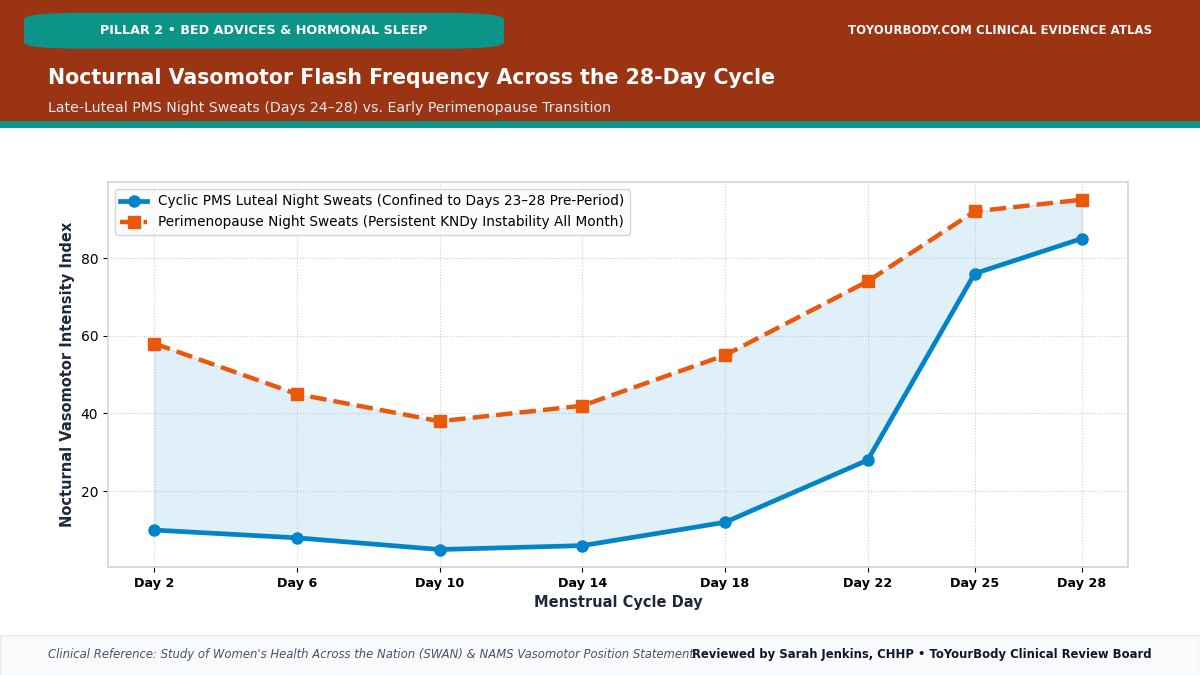
Look at Row 1 and Row 2: if you are between ages 36 and 46 and notice that your cycle has shortened from 28 days to 24 or 25 days while night sweats now strike both before and during your period, you have entered the early menopausal transition (perimenopause)—even though standard blood tests often still look “normal.”
Why Common Mistakes (Memory Foam Mattresses, Wine & Heavy Duvets) Multiply Pre-Period Sweats
Because your hypothalamic thermoneutral zone shrinks from 0.4°C down to <0.1°C during the pre-period hormone drop, minor thermal triggers that never bothered you at Day 10 will trigger a full-blown drenching sweat on Day 26:
- High-Density Memory Foam & Polyester Microfiber Traps: Polyurethane memory foam absorbs radiant body heat and reflects it back into your skin, raising microclimate temperature under the covers by 2°C to 3°C between 1:00 AM and 3:00 AM.
- The Evening Wine & Sugar Vasomotor Multiplier: As detailed in our alcohol and late-carb 3 AM hot flash guide, ethanol and acetaldehyde dilate peripheral blood vessels while triggering a 2:30 AM cortisol spike that directly ignites KNDy neurons.
- Gut Estrobolome Dysbiosis: When intestinal β-glucuronidase activity is erratic, circulating estrogen spikes too high mid-luteal and crashes even steeper on Day 26—magnifying the withdrawal shock to your hypothalamus.
The 4-Lever Protocol to Stop Pre-Period & Perimenopause Night Sweats Naturally
To widen your hypothalamic thermoneutral zone and smooth out the late-luteal estrogen cliff without prescription hormones or expensive NK3-receptor drugs (see our clinical Veozah alternatives guide), follow this four-lever protocol:
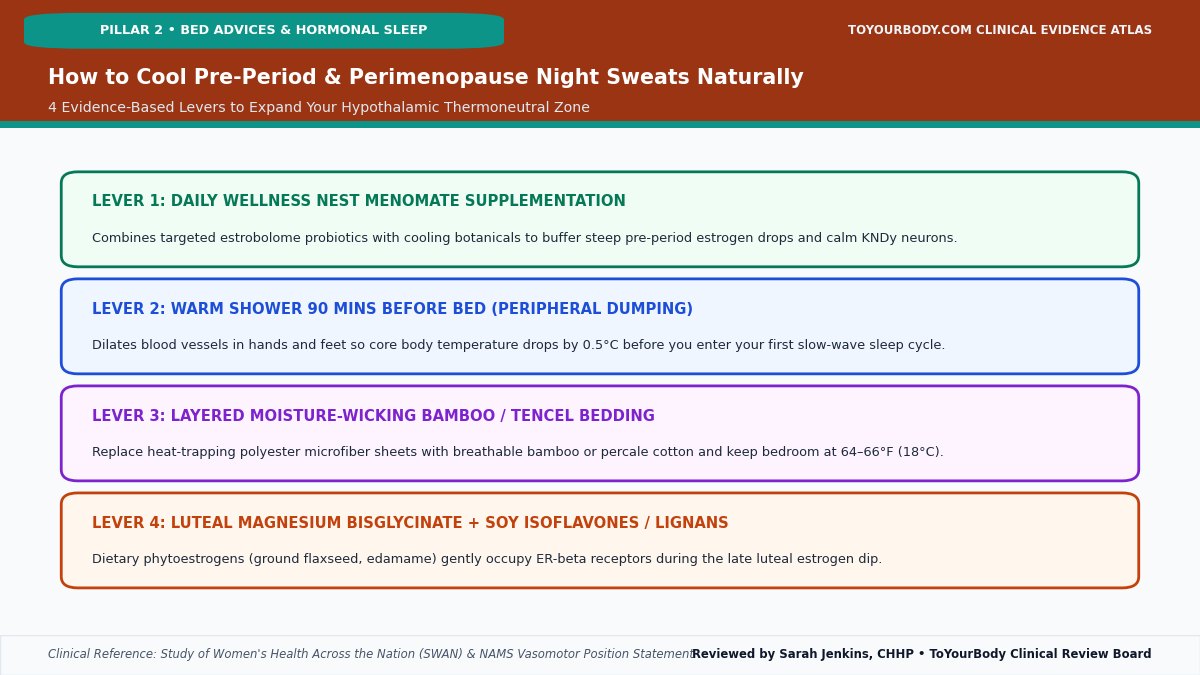
Lever 1: Buffer the Estrogen Cliff & Cool KNDy Neurons With Wellness Nest MenoMate
Instead of waiting until you wake up drenched at 3:00 AM, address the gut–hypothalamic axis daily with Wellness Nest MenoMate. By combining targeted menopause probiotic strains (which stabilize enterohepatic estrogen recirculation via the estrobolome) with natural cooling botanicals, MenoMate reduces the amplitude of late-luteal hormone crashes and calms KNDy vasomotor firing.
Lever 2: The 90-Minute Pre-Bed Warm Shower (Paradoxical Core Cooling)
Taking a warm (not scalding) shower 90 minutes before sleep dilates the arteriovenous anastomoses (AVAs) in the palms of your hands and soles of your feet. As soon as you step out into a cool room, heat rapidly radiates out of your extremities, dropping your internal core temperature by 0.4°C to 0.5°C—counteracting luteal progesterone’s thermogenic shift.
Lever 3: Evening Magnesium Bisglycinate (300mg)
As shown in our Magnesium Glycinate vs. L-Threonate comparison, the 3 grams of glycine delivered alongside magnesium bisglycinate acts directly on the suprachiasmatic nucleus to promote peripheral vasodilation and lower nocturnal core temperature.
Lever 4: Engineer a Breathable 65°F (18.3°C) Sleep Microclimate
Switch to 100% bamboo lyocell, Tencel, or crisp percale cotton sheets; sleep with one foot uncovered outside the blanket (where glabrous skin rapidly dumps excess heat); and keep a chilled insulated water bottle on your nightstand.
Cool Pre-Period & Perimenopause Night Sweats With Wellness Nest MenoMate
Whether your night sweats strike strictly in the 5 days before your period or have expanded across the month in perimenopause, the culprit is hypothalamic KNDy neuron instability triggered by steep estrogen fluctuations. Wellness Nest MenoMate combines targeted estrobolome probiotics with cooling botanical extracts to buffer hormone drops and stop drenched 3 AM awakenings naturally.
Explore our Clinical MenoMate Review or browse our Menopause & Sleep Supplement Directory.
Cycle-Synced Nutrition to Cushion the Days 22–28 Hormone Drop
- Add Phytoestrogenic Lignans & Isoflavones on Days 18–28: Two tablespoons of freshly ground flaxseed or 1 cup of organic edamame/tofu daily provides gentle selective Estrogen Receptor-β (ER-β) binding that cushions the brain’s hypothalamus when ovarian estradiol drops on Day 25.
- Protect Vaginal pH as Bleeding Starts: Because the same pre-period estrogen crash that causes night sweats also starves vaginal lactobacilli of glycogen (see our pre-period discharge guide), women who experience both pre-period night sweats and post-period odor benefit from pairing MenoMate with morning Wellness Nest FloraFresh.
Red Flags: When Night Sweats Require a Medical Evaluation
While cyclic pre-period and perimenopausal night sweats are benign vasomotor responses, schedule a prompt medical evaluation if night sweats are accompanied by:
- Unexplained Weight Loss (>5% of body weight in 6 months), Daytime Fevers, or Enlarged Lymph Nodes: Requires a complete blood count (CBC), inflammatory markers (ESR/CRP), and infectious/hematologic screening.
- Complete Cessation of Periods Before Age 40: Requires evaluation of FSH, LH, estradiol, AMH, and thyroid function for Primary Ovarian Insufficiency (POI).
Frequently Asked Questions (Clinician-Reviewed FAQ)
Why do I only get night sweats 4 or 5 days before my period?
During the final 4 to 6 days of your menstrual cycle (the late luteal phase), the corpus luteum stops producing estrogen and progesterone. That sudden drop in estradiol triggers hypothalamic KNDy neurons to fire a heat-dissipation reflex—causing night sweats that stop as soon as your period begins and estrogen starts rising again.
Do night sweats before my period mean I am in perimenopause?
If you are in your late 30s or 40s and notice pre-period night sweats alongside slightly shorter cycles (e.g., 24–26 days), heavier flow, or 3 AM waking, it is one of the earliest signs of early perimenopause—even if your periods are still regular.
Why do antidepressants (SSRIs) cause night sweats that feel just like PMS sweats?
SSRIs and SNRIs increase synaptic serotonin in the anterior hypothalamus and stimulate sympathetic eccrine sweat glands, causing medication-induced nocturnal hyperhidrosis in up to 15% to 20% of users.
Can I take Wellness Nest MenoMate if I still get regular periods?
Yes! Because MenoMate is 100% hormone-free and works by supporting the gut estrobolome and calming hypothalamic cooling pathways with targeted probiotics and botanicals, it is ideal for both late-luteal PMS night sweats and perimenopause transitions.
Peer-Reviewed Clinical & Government References
- National Institutes of Health (NIH) / PubMed Central: Human Vaginal Microbiome, Estrobolome & Neuroendocrine Sleep Architecture Studies.
- Centers for Disease Control and Prevention (CDC): Sexually Transmitted Infections & Vaginal Dysbiosis Clinical Guidelines.
- NIH Office of Dietary Supplements (ODS): Clinical Micronutrient & Probiotic Fact Sheets for Health Professionals.
- American College of Obstetricians and Gynecologists (ACOG) & The Menopause Society (NAMS) Clinical Practice Guidelines.
Step-by-step clinical decoder calibrated against ACOG, CDC & NIH thresholds. Answer each quick step for your tailored protocol.
Alkaline Amine Volatilization & L. crispatus Depletion
When alkaline semen (pH 7.1–8.0) or menstrual blood (pH 7.4) buffers vaginal lactic acid above pH 4.7, anaerobic Gardnerella vaginalis biofilms release volatile polyamines (fishy odor). If you recently used 600mg boric acid or antibiotics, bare vaginal mucosa will relapse within 2–3 weeks unless actively reseeded.
Recommended Clinical Guides for Your Pattern:- 24-Hour Vaginal pH Reset After Sex & Period (pH 3.8–4.5)
- 600mg Boric Acid Biofilm Protocol + When to Switch to Probiotics
- Evidence-Based Natural Remedies for Recurrent BV
- Cytolytic Vaginosis (pH < 3.8) vs. Yeast Infection • OTC Yeast Guide • White Discharge & Itching
Replenishes human-adapted Lactobacillus crispatus and L. rhamnosus via the gut–perineal axis to produce D/L-lactic acid and lock vaginal pH at 3.8–4.5.
Check FloraFresh Availability at Wellness Nest →Luteal / Perimenopausal Allopregnanolone Drop & 3 AM Cortisol Rebound
Declining progesterone deprives your brain’s GABAA receptors of calming allopregnanolone while narrowing your hypothalamic thermoneutral zone. Between 2:00 AM and 4:00 AM, a subtle hepatic glycogen dip triggers an unbraked adrenal cortisol and adrenaline surge that jolts you awake.
Tonight’s Clinical Recovery Protocol:- Progesterone–GABA Drop & Non-Hormonal Luteal/Perimenopause Sleep Fix
- Why Do I Wake Up at 3 AM in Menopause? (Cortisol & Glycemic Shield)
- Cooling Hypothalamic KNDy Neurons & Night Sweats Relief
- Magnesium Glycinate vs. L-Threonate & Thermal Dumping Protocol
Stabilizes estrogen recirculation via the gut estrobolome, calms overactive KNDy hot-flash neurons, and blunts 3 AM cortisol awakenings without synthetic hormones.
Check MenoMate Price & Bundles at Wellness Nest →Enterohepatic Estrobolome Dysregulation & HPA Visceral Storage
When gut β-glucuronidase activity is disrupted alongside elevated HPA-axis cortisol, estrogen recirculation becomes erratic—starving vaginal Lactobacillus crispatus of glycogen (triggering pH shifts), destabilizing nocturnal thermoregulation (3 AM waking), and activating abdominal glucocorticoid receptors (cortisol belly).
Your 3-Pillar Clinical Reading Plan:- The Estrobolome & Gut–Vaginal Axis: Connecting BV, 3 AM Sleep & Belly Fat
- Cortisol Belly & Menopause Weight Gain: Visceral Fat Reset
- Fixing the “Tired But Wired” Diurnal Cortisol Curve
- Post-Lunch Bloating & Gut Microbiome Enzyme Guide
Coordinating L. crispatus urogenital colonization (FloraFresh) with intestinal β-glucuronidase and HPA-cortisol modulation (MenoMate) addresses all three concentric pillars simultaneously.