For millions of women in late perimenopause and postmenopause, two frustrating conditions seem to arrive hand in hand: persistent vaginal dryness, burning, or sandpaper-like friction during daily life or intimacy, and a sudden epidemic of recurrent urinary tract infections (UTIs) that come back every few weeks despite endless rounds of Macrobid, Keflex, or Cipro.
Often, urologists treat the bladder with repeated antibiotics—which further destroy your microbiome, as we explain in our antibiotic microbiome shield guide—while overlooking the true anatomical root cause located just two centimeters away: a high-pH (>5.0), Lactobacillus-depleted postmenopausal vaginal introitus.
In this flagship Intimate & Vaginal Health clinical guide, we trace the exact physiological chain reaction connecting menopausal estrogen decline, vaginal pH elevation, and recurrent UTIs—and outline the complete non-hormonal and integrative restoration protocol.
Clinical Key Takeaways: Solving Postmenopausal High pH, Dryness & UTIs
- Root Physiological Mechanism: According to The Menopause Society (NAMS) and American Urological Association (AUA) guidelines, over 50% of postmenopausal women experience Genitourinary Syndrome of Menopause (GSM)—where declining estradiol thins the vaginal epithelium and reduces intracellular glycogen by more than 70%.
- Why Symptoms Persist or Relapse: Without estrogen-driven glycogen to ferment, native Lactobacillus crispatus starves and disappears, causing postmenopausal vaginal pH to rise permanently from 3.8–4.5 up to 5.0–6.5+. This loss of the acidic introital barrier allows uropathogenic Escherichia coli (UPEC) to colonize the vaginal vestibule and ascend the short female urethra, triggering relentless recurrent UTIs.
- Evidence-Based Recovery Protocol: Breaking the postmenopausal UTI–antibiotic loop requires restoring urogenital lactic acid and anti-adhesion defense via Wellness Nest FloraFresh (L. crispatus + Cranberry PACs) paired with Wellness Nest MenoMate estrobolome support and iso-osmolar hyaluronic acid hydration.
The Estrogen–Glycogen–Lactobacillus Triangle: Why Vaginal pH Rises Above 5.0 After Menopause
During your reproductive years, your vaginal wall is composed of 25 to 40 thick, rugated layers of stratified squamous epithelium rich in Estrogen Receptors (α and β). Circulating estradiol (E2)—maintained by ovarian secretion and gut estrobolome recirculation—performs two vital tasks in the urogenital tract:
- Structural Blood Flow & Mucosal Thickness: Estradiol stimulates dermal collagen, elastin, hyaluronic acid mucopolysaccharides, and subepithelial capillary perfusion, keeping the vaginal walls plush, elastic, and naturally lubricated.
- Intracellular Glycogen Production (Fuel for Lactobacillus): Estradiol commands superficial and intermediate squamous cells to synthesize and store massive amounts of glycogen. As these cells naturally exfoliate into the vaginal lumen, resident Lactobacillus crispatus, L. jensenii, and L. gasseri break down that glycogen via α-amylase into maltose and ferment it into D- and L-lactic acid, locking vaginal pH between 3.8 and 4.5.
What Happens in Genitourinary Syndrome of Menopause (GSM)
When systemic estradiol drops from premenopausal levels (40–300 pg/mL) to postmenopausal levels (<15 pg/mL), the vaginal epithelium thins down to just a few fragile basal and parabasal cell layers. Glycogen shedding grinds to a halt. Starved of their carbohydrate fuel source, protective lactobacilli plummet from >90% dominance to <10%, and intravaginal pH climbs to 5.0, 6.0, or even 6.8.
How High Vaginal pH Directly Causes Recurrent Postmenopausal UTIs
In a healthy vagina at pH 4.0, protonated lactic acid and hydrogen peroxide form an impenetrable chemical moat around the external urethral meatus (opening). Colonic bacteria like uropathogenic Escherichia coli (UPEC), Klebsiella, and Enterococcus cannot survive in pH 4.0 acid. Once postmenopausal vaginal pH rises above 5.0, that acidic moat vanishes: E. coli from the perineum colonizes the dry, high-pH vaginal vestibule, attaches via P-fimbriae and Type 1 pili to urothelial receptors, and ascends the 4-centimeter female urethra into the bladder trigone.
Clinical Comparison: Premenopausal Homeostasis vs. Untreated GSM vs. Restored Postmenopausal Microbiome
Compare the structural, biochemical, and microbiological markers of the female urogenital tract across menopausal transitions in the clinical table below:
| Urogenital Biomarker | Premenopausal Healthy Baseline | Untreated Postmenopausal GSM | Restored Postmenopausal Protocol (FloraFresh + MenoMate) |
|---|---|---|---|
| Intravaginal Sidewall pH | 3.8 – 4.5 (Lactic acid buffered) | 5.0 – 6.5+ (Unbuffered alkaline shift) | 4.0 – 4.5 (Re-acidified via oral L. crispatus & mucosal hydration) |
| Vaginal Maturation Index (VMI) | Dominated by glycogen-rich superficial & intermediate cells | Dominated by fragile, low-glycogen parabasal cells | Improved mucosal integrity, reduced micro-fissures & shedding |
| Dominant Microbiome | >90% Lactobacillus crispatus, L. jensenii, L. gasseri | Depleted lactobacilli; overgrown with E. coli, Streptococcus, Gardnerella | Replenished L. crispatus, L. rhamnosus GR-1 & L. reuteri RC-14 |
| Urethral & Bladder Trigone Defense | Strong acidic & bacteriocin moat blocks uropathogens | Frequent dysuria, urgency, & 3+ recurrent UTIs per year | Cranberry A-type PACs + Lactobacilli block P-fimbriae E. coli adhesion |
| Clinical Symptoms | Natural lubrication, comfortable intimacy, odor-free | Dryness, burning, dyspareunia, yellow/watery discharge, UTIs | Restored daily comfort, balanced pH, and urinary tract resilience |
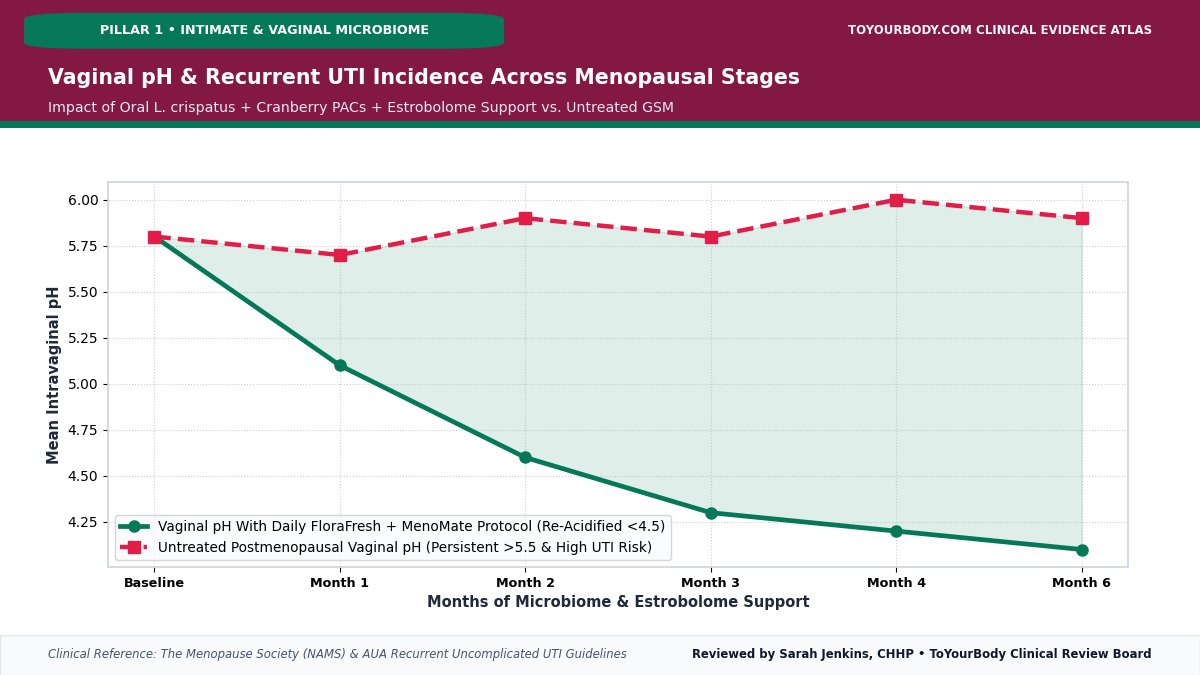
Notice why a postmenopausal woman with a vaginal pH of 5.8 often gets misdiagnosed with “chronic BV” and prescribed repeated Flagyl courses: her high pH is actually driven by estrogen-glycogen depletion and Lactobacillus starvation (GSM), not simply an acute infection.
Why Repeated UTI Antibiotics Trap Postmenopausal Women in a Vicious Cycle
When a postmenopausal woman presents with urinary frequency, urgency, or burning, she is routinely prescribed ciprofloxacin, cephalexin, or trimethoprim-sulfamethoxazole. While the antibiotic clears planktonic bacteria in the bladder urine for 7 days, it simultaneously:
- Wipes Out Remaining Vaginal & Perineal Lactobacilli: Ensuring vaginal pH stays elevated above 5.5 so the vaginal introitus remains a permanent staging ground for the next E. coli invasion.
- Selects for Multi-Drug Resistant Uropathogens & Intracellular Bacterial Communities (IBCs): Uropathogenic E. coli can burrow into superficial bladder umbrella cells to form dormant intracellular biofilms that re-emerge as soon as antibiotics stop.
- Leaves GSM Atrophic Burning Untouched: Sometimes postmenopausal urethral and vestibular burning (dysuria) is caused by raw, high-pH atrophic tissue rather than an active bladder infection—leading to negative urine cultures and unnecessary antibiotic exposure.
The 4-Pillar Postmenopausal Vaginal pH & UTI Prevention Protocol
Clinical urogynecology research proves that you can restore a protective acidic vaginal pH and dramatically cut recurrent UTI rates after menopause by combining targeted oral urogenital probiotics, anti-adhesion proanthocyanidins, estrobolome support, and mucosal hydration:
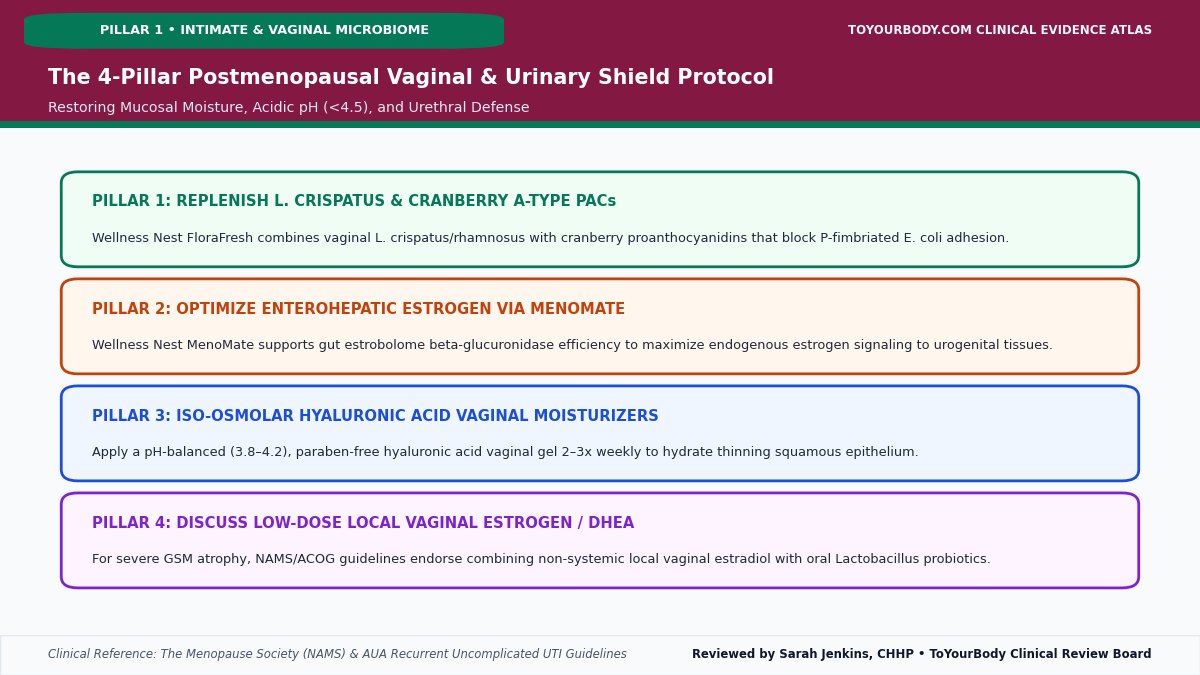
Pillar 1: Daily Oral L. crispatus, L. rhamnosus & Cranberry PACs (Wellness Nest FloraFresh)
Landmark randomized controlled trials in postmenopausal women (such as Beerepoot et al., Archives of Internal Medicine) demonstrated that daily oral supplementation with Lactobacillus rhamnosus GR-1 and L. reuteri RC-14—paired with Lactobacillus crispatus—successfully translocates across the perineum to recolonize the postmenopausal vaginal introitus and reduce recurrent UTIs without inducing antibiotic resistance. Wellness Nest FloraFresh combines these exact vaginal Lactobacillus strains with concentrated Organic Cranberry Extract rich in A-type proanthocyanidins (PACs), which physically wrap around E. coli P-fimbriae so bacteria cannot hook onto your urethral or bladder wall.
Pillar 2: Support Endogenous Estrogen Recycling & Vasomotor Calm With MenoMate
Even after menopause, your adrenal glands and peripheral tissues continue to produce estrone (E1) and estradiol precursors that circulate through the liver and gut. Supporting your gut estrobolome with Wellness Nest MenoMate optimizes healthy intestinal hormone metabolism while calming 3 AM night sweats and sleep fragmentation.
Pillar 3: Apply Iso-Osmolar Hyaluronic Acid Vaginal Moisturizers (2–3x Weekly)
Unlike sexual lubricants (used only during intimacy), a paraben-free, iso-osmolar hyaluronic acid vaginal hydrogel buffered to pH 3.8–4.2 binds water directly into thinning squamous epithelial cells, supplying moisture and supporting an acidic microenvironment for your oral FloraFresh strains to thrive.
Pillar 4: Coordinate With Low-Dose Local Vaginal Estrogen or DHEA When Indicated
Per 2020–2026 AUA Recurrent UTI Guidelines and NAMS recommendations, low-dose local vaginal estrogen (estradiol cream, tablet, or ring) or intravaginal prasterone (DHEA) has minimal systemic absorption and works synergistically alongside oral Lactobacillus crispatus probiotics to restore epithelial glycogen.
The Dual Postmenopausal Urogenital Shield: FloraFresh + MenoMate
In late perimenopause and postmenopause, protecting the vaginal and urinary tracts requires addressing both sides of the Estrogen–Lactobacillus equation. Wellness Nest FloraFresh delivers targeted Lactobacillus crispatus, L. rhamnosus, and A-type Cranberry PACs to re-acidify the introitus and block E. coli urethral adhesion, while Wellness Nest MenoMate supports gut estrobolome hormone recycling and nocturnal vasomotor comfort.
Daily Bladder & Vulvar Habits That Protect Thinning Postmenopausal Tissue
- Front-to-Back Perineal Care & Post-Coital Hydration: Drink a full 8 oz glass of water before intimacy, use a glycerin-free, pH-balanced silicone or hyaluronic lubricant to prevent micro-abrasions, and urinate gently within 15 minutes afterward.
- Ban All Soap & Scented Wipes From the Vulvar Vestibule: Thin postmenopausal mucosa lacks a thick keratin barrier; commercial body washes Have an alkaline pH of 8.0–10.0 that strips remaining lipids and triggers chemical vulvitis.
- Test Your Progress With Our Interactive Decoder: Track your vaginal pH shift from >5.0 back down toward 4.0–4.5 using colorimetric pH strips and our 60-Second Vaginal pH & Discharge Clinical Decoder.
When Postmenopausal Urinary or Vaginal Symptoms Require Urgent Evaluation
Always seek an in-office urogynecological exam if you experience:
- Any Postmenopausal Vaginal Bleeding or Pink/Brown Spotting: While thin atrophic tissue can occasionally spot after friction, ACOG mandates evaluating all postmenopausal bleeding via transvaginal ultrasound or endometrial sampling to rule out endometrial hyperplasia or malignancy.
- Flank/Back Pain, Chills, Fever, or Visible Blood in Urine (Hematuria): Signals a potential upper urinary tract infection (pyelonephritis) or requires urological imaging.
Frequently Asked Questions (Clinician-Reviewed FAQ)
Why is my vaginal pH 5.5 or 6.0 after menopause even when I don’t have BV?
After menopause, declining estrogen reduces the glycogen stored inside vaginal epithelial cells. Because protective Lactobacillus crispatus bacteria rely on glycogen to make lactic acid, lactobacilli decline and vaginal pH naturally rises above 5.0—a hallmark of Genitourinary Syndrome of Menopause (GSM).
Can oral probiotics like FloraFresh work if my estrogen is low?
Yes. Clinical trials in postmenopausal women show that orally ingested Lactobacillus rhamnosus GR-1, L. reuteri RC-14, and L. crispatus successfully migrate across the perineum to colonize the vaginal introitus and lower pH, especially when paired with cranberry PACs and a pH-balanced hyaluronic acid moisturizer.
Why do I keep getting E. coli UTIs every month after turning 50?
The loss of acidic vaginal pH (3.8–4.5) removes the protective antibacterial barrier around the urethral opening. Colonic E. coli first colonizes the high-pH vaginal introitus and then ascends into the bladder. Restoring vaginal lactobacilli and cranberry A-type PACs with FloraFresh blocks this colonization at the door.
Should I take FloraFresh and MenoMate together after menopause?
Yes. FloraFresh directly targets the urogenital Lactobacillus and cranberry anti-adhesion shield (Pillar 1), while MenoMate targets the gut estrobolome, nocturnal hot flashes, and HPA-axis cortisol balance (Pillars 2 & 3).
Peer-Reviewed Clinical & Government References
- National Institutes of Health (NIH) / PubMed Central: Human Vaginal Microbiome, Estrobolome & Neuroendocrine Sleep Architecture Studies.
- Centers for Disease Control and Prevention (CDC): Sexually Transmitted Infections & Vaginal Dysbiosis Clinical Guidelines.
- NIH Office of Dietary Supplements (ODS): Clinical Micronutrient & Probiotic Fact Sheets for Health Professionals.
- American College of Obstetricians and Gynecologists (ACOG) & The Menopause Society (NAMS) Clinical Practice Guidelines.
Step-by-step clinical decoder calibrated against ACOG, CDC & NIH thresholds. Answer each quick step for your tailored protocol.
Alkaline Amine Volatilization & L. crispatus Depletion
When alkaline semen (pH 7.1–8.0) or menstrual blood (pH 7.4) buffers vaginal lactic acid above pH 4.7, anaerobic Gardnerella vaginalis biofilms release volatile polyamines (fishy odor). If you recently used 600mg boric acid or antibiotics, bare vaginal mucosa will relapse within 2–3 weeks unless actively reseeded.
Recommended Clinical Guides for Your Pattern:- 24-Hour Vaginal pH Reset After Sex & Period (pH 3.8–4.5)
- 600mg Boric Acid Biofilm Protocol + When to Switch to Probiotics
- Evidence-Based Natural Remedies for Recurrent BV
- Cytolytic Vaginosis (pH < 3.8) vs. Yeast Infection • OTC Yeast Guide • White Discharge & Itching
Replenishes human-adapted Lactobacillus crispatus and L. rhamnosus via the gut–perineal axis to produce D/L-lactic acid and lock vaginal pH at 3.8–4.5.
Check FloraFresh Availability at Wellness Nest →Luteal / Perimenopausal Allopregnanolone Drop & 3 AM Cortisol Rebound
Declining progesterone deprives your brain’s GABAA receptors of calming allopregnanolone while narrowing your hypothalamic thermoneutral zone. Between 2:00 AM and 4:00 AM, a subtle hepatic glycogen dip triggers an unbraked adrenal cortisol and adrenaline surge that jolts you awake.
Tonight’s Clinical Recovery Protocol:- Progesterone–GABA Drop & Non-Hormonal Luteal/Perimenopause Sleep Fix
- Why Do I Wake Up at 3 AM in Menopause? (Cortisol & Glycemic Shield)
- Cooling Hypothalamic KNDy Neurons & Night Sweats Relief
- Magnesium Glycinate vs. L-Threonate & Thermal Dumping Protocol
Stabilizes estrogen recirculation via the gut estrobolome, calms overactive KNDy hot-flash neurons, and blunts 3 AM cortisol awakenings without synthetic hormones.
Check MenoMate Price & Bundles at Wellness Nest →Enterohepatic Estrobolome Dysregulation & HPA Visceral Storage
When gut β-glucuronidase activity is disrupted alongside elevated HPA-axis cortisol, estrogen recirculation becomes erratic—starving vaginal Lactobacillus crispatus of glycogen (triggering pH shifts), destabilizing nocturnal thermoregulation (3 AM waking), and activating abdominal glucocorticoid receptors (cortisol belly).
Your 3-Pillar Clinical Reading Plan:- The Estrobolome & Gut–Vaginal Axis: Connecting BV, 3 AM Sleep & Belly Fat
- Cortisol Belly & Menopause Weight Gain: Visceral Fat Reset
- Fixing the “Tired But Wired” Diurnal Cortisol Curve
- Post-Lunch Bloating & Gut Microbiome Enzyme Guide
Coordinating L. crispatus urogenital colonization (FloraFresh) with intestinal β-glucuronidase and HPA-cortisol modulation (MenoMate) addresses all three concentric pillars simultaneously.