Every single month during the week before your period starts, you look down at your underwear and wonder: “Is this watery or milky white discharge normal pre-period hormone fluid, an early pregnancy sign, or the beginning of a BV or yeast infection?”
Because the vaginal canal and cervix respond dynamically to every rise and fall of estradiol and progesterone across your 28-day cycle, vaginal discharge color and texture change dramatically between ovulation (Day 14) and the day your period arrives (Day 28).
Within our Intimate & Vaginal Health diagnostic hub, this clinical guide shows you how to tell healthy luteal milky discharge apart from early Bacterial Vaginosis, Cytolytic Vaginosis, and Candida yeast infections using pH testing, scent chemistry, and cycle physiology.
Clinical Key Takeaways: Decoding Pre-Period Watery vs. Milky Discharge
- Root Physiological Mechanism: Creamy or milky-white, lotion-like discharge in the 7 to 10 days before your period is typically 100% physiological—driven by post-ovulatory corpus luteum progesterone thickening endocervical mucus while Lactobacillus crispatus maintains a healthy pH of 3.8–4.5.
- Why Symptoms Persist or Relapse: By contrast, a sudden shift to thin, watery, grayish-white discharge accompanied by a fishy or musty scent in the days right before bleeding signals early Bacterial Vaginosis (pH > 4.7) triggered by late-luteal estrogen withdrawal starving your lactobacilli of glycogen.
- Evidence-Based Recovery Protocol: If pre-period discharge is thick, white, pasty/clumpy with vulvar burning that vanishes once menstrual flow begins, suspect hyper-acidic Cytolytic Vaginosis (pH < 3.8) rather than a yeast infection.
The Endocrinology of Pre-Period Discharge: How Estrogen & Progesterone Shape Vaginal Fluid
What we call “vaginal discharge” is actually a carefully orchestrated biological blend of two fluids: (1) cervical mucus secreted by crypts in the endocervical canal, and (2) vaginal transudate containing shed squamous epithelial cells, water, electrolytes, and lactic acid produced by your resident Lactobacillus microbiome—the core mechanism of the self-cleaning vagina.
According to reproductive endocrinology standards from ACOG and NIH cervical mucus physiology studies, your cycle moves through four distinct fluid phases:
- Days 6–11 (Follicular Phase): Rising estradiol stimulates crypts to produce scant-to-moderate sticky or creamy mucus.
- Days 12–15 (Ovulatory Peak): Surge-level estradiol stimulates abundant MUC5B mucin hydrogels that are 98% water—creating slippery, transparent, stretchy “egg-white” cervical mucus (pH ~7.0 at the cervical os) designed to nourish and transport sperm.
- Days 16–24 (Mid-Luteal Progesterone Dominance): Once the corpus luteum forms and secretes progesterone, progesterone immediately shuts down watery MUC5B secretion, decreases water content, and increases cellular shedding. The result is smooth, opaque, milky-white or lotion-like discharge that is odorless (or mildly tangy) and leaves a faint pale-ivory or yellowish tint when oxidized on dark cotton underwear.
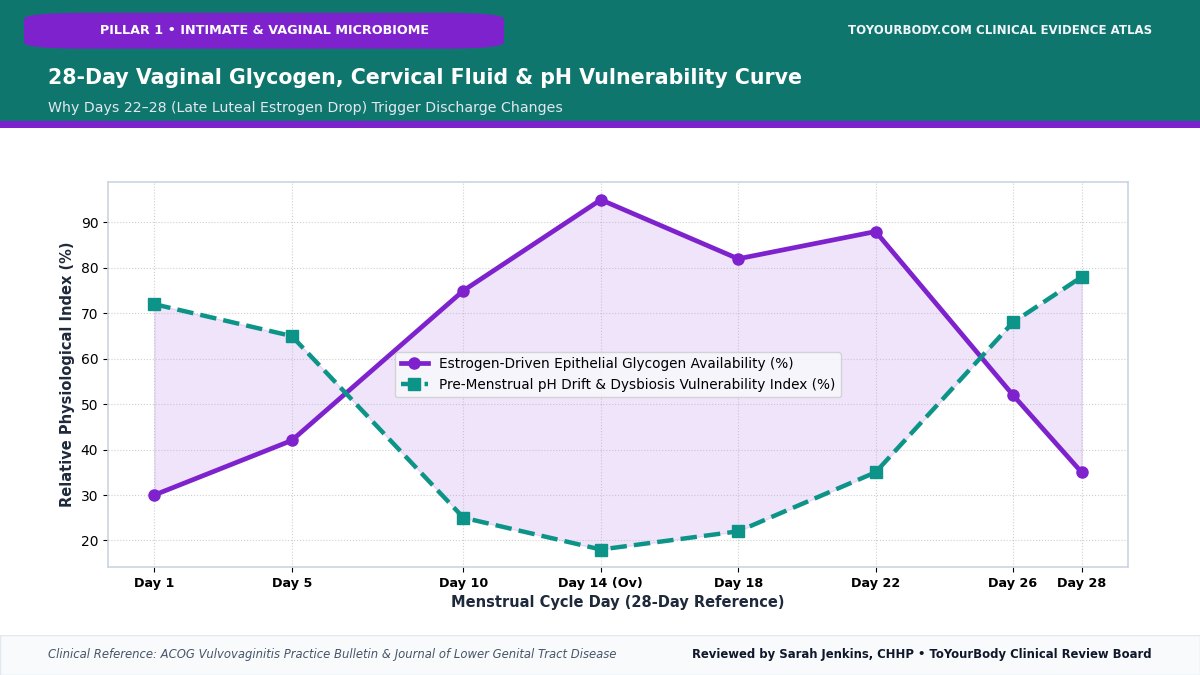
- Days 25–28 (Late-Luteal Hormone Withdrawal): In the final 48 to 72 hours before menstruation, both progesterone and estradiol plummet. As the endometrial lining prepares to shed and pre-menstrual pelvic vascular congestion peaks, a brief transudate of clear-to-watery fluid can appear right before spotting starts—OR, if your Lactobacillus reserve is low, the sudden drop in estrogen-driven glycogen allows anaerobic bacteria to bloom into early watery BV.
Differential Diagnosis Table: Milky White vs. Watery vs. Clumpy Discharge Before Your Period
Use the clinical comparison matrix below (or plug your exact symptoms into our Interactive 60-Second Vaginal pH & Discharge Decoder) to identify what your pre-period discharge means:
| Pre-Period Discharge Type | Texture & Visual Appearance | Vaginal Wall pH | Scent & Vulvar Sensation | Underlying Clinical Cause |
|---|---|---|---|---|
| Normal Luteal Milky Mucus | Smooth, creamy, lotion-like opaque white; non-stretchy | 3.8 – 4.5 (Healthy Acidic) | Odorless or faintly clean/tangy; zero itching or burning | Physiological corpus luteum progesterone + healthy L. crispatus |
| Pre-Menstrual Watery Transudate | Clear or slightly cloudy thin liquid 1–2 days before flow | 3.8 – 4.5 | Odorless (or faint coppery hint right before spotting); no itch | Normal pelvic vascular transudate & luteal progesterone drop |
| Early Bacterial Vaginosis (BV) | Thin, watery, homogeneous milky-gray coating vaginal walls | 4.8 – 6.0+ (Alkaline Shift) | Distinct fishy amine odor (especially after sex); mild irritation | Late-luteal glycogen dip + Gardnerella vaginalis biofilm bloom |
| Cytolytic Vaginosis (CV) | Thick, white, pasty or clumpy (shredded skin cells) | 3.0 – 3.8 (Hyper-Acidic) | Sour/vinegar scent; raw burning & stinging with urination | Excessive Lactobacillus acid lysing glycogen-rich luteal cells |
| Luteal Yeast Infection (VVC) | Thick white cottage-cheese curds adhering to labia | 4.0 – 4.5 | Odorless; intense vulvar itching, redness, swelling | Candida albicans thriving on high luteal epithelial glycogen |
Look closely at Row 2 versus Row 3 in the table above: watery discharge before your period can be either completely normal transudate OR early Bacterial Vaginosis. The single fastest way to tell them apart is checking whether the watery fluid has a pH above 4.7 and a fishy amine scent.
Why the Week Before Your Period Is the #1 Danger Zone for Microbiome Shifts
Why do so many women feel completely fine during the first two weeks of their cycle, only to experience discharge changes, odor, or itching between Days 21 and 28? Three converging physiological mechanisms are at work:
- The Luteal Glycogen Rollercoaster: Mid-luteal estrogen and progesterone pack vaginal epithelial cells with glycogen—which can temporarily over-feed yeast (triggering pre-period Candida flares) or over-acidify the canal in Cytolytic Vaginosis. Then, on Days 25–28, estrogen crashes abruptly, cutting off glycogen supply right before alkaline menstrual blood (pH 7.4) arrives.
- Progesterone-Mediated Mucosal Immune Modulation: High luteal progesterone naturally downregulates certain local cell-mediated immune responses in the reproductive tract (an evolutionary adaptation to prevent rejection of an implanting embryo), temporarily lowering mucosal surveillance against opportunistic Candida and Gardnerella.
- Gut–Vaginal Bloating & Constipation Spillover: As we explain in our guide on why bloating gets worse before your period, luteal progesterone slows intestinal transit, increasing rectal microbial load near the perineal bridge.
The 4-Step Pre-Period Microbiome Stabilization Protocol
Instead of guessing every month or reaching for unnecessary over-the-counter antifungal creams that irritate delicate tissue, follow this four-step clinical protocol during the second half of your cycle:
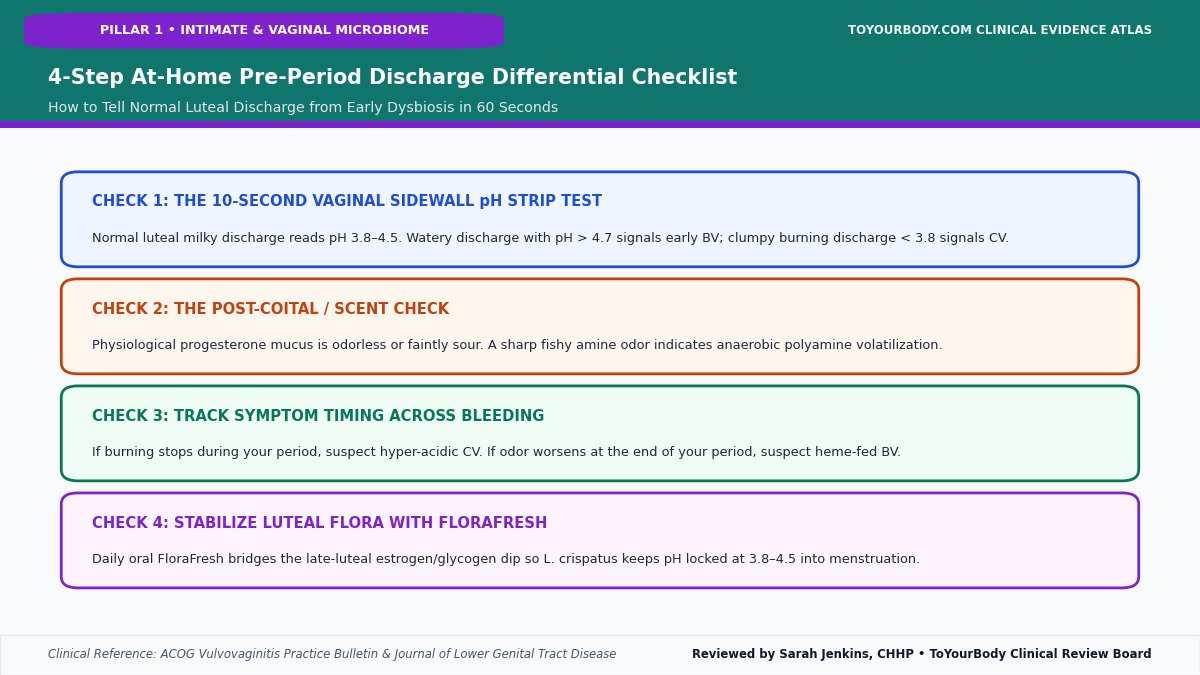
Step 1: Keep Colorimetric Vaginal pH Strips in Your Bathroom Cabinet
Whenever pre-period discharge looks unusually watery or abundant, press a vaginal pH swab against the mid-vaginal sidewall for 5 seconds. If your pH is between 3.8 and 4.5 with no itching or fishy odor, your milky or watery luteal discharge is healthy physiological fluid—leave it alone!
Step 2: Bridge the Late-Luteal Estrogen Dip With Daily FloraFresh
If your pre-period watery discharge consistently drifts above pH 4.7 or turns fishy right before and during your period, your native Lactobacillus population lacks the density to survive the late-luteal glycogen drop. Taking Wellness Nest FloraFresh daily supplies acid-resilient Lactobacillus crispatus, L. rhamnosus, and L. reuteri plus cranberry proanthocyanidins to maintain uninterrupted lactic acid output across all 28 days.
Step 3: Switch to Breathable Cotton Liners & Lukewarm External Rinses
Heavy luteal milky discharge trapped against synthetic nylon thongs or plastic-backed pantyliners creates a warm, alkaline microclimate. Wear 100% organic cotton underwear and rinse the external vulva with lukewarm water only—never douche, as detailed in our post-sex and post-period vaginal pH reset guide.
Step 4: Reserve Boric Acid Strictly for Confirmed Alkaline Biofilm Relapses
If a pH strip confirms pH > 4.8 alongside a fishy amine odor that persists after menses, review our 600mg boric acid biofilm disruption + probiotic transition protocol.
Stabilize Your Pre-Period Microbiome With Wellness Nest FloraFresh
During the final 5 to 7 days before your period, falling estrogen reduces vaginal glycogen fuel just as cervical mucus shifts—creating a prime window for pH drift and early Bacterial Vaginosis. Daily Wellness Nest FloraFresh keeps Lactobacillus crispatus and L. rhamnosus saturated at the vaginal wall so your pH stays locked at 3.8–4.5 all the way through menstruation.
Read our Clinical FloraFresh Review or compare verified formulas in our Women’s Health Products Hub.
Could Milky White Discharge Before Your Period Be an Early Sign of Pregnancy?
One of the most frequent questions women ask when noticing abundant milky-white lotion-like discharge at Days 24–28 is whether it represents early pregnancy leukorrhea:
- Why They Look Identical at Days 22–26: Both a normal luteal phase and a newly conceived pregnancy are dominated by corpus luteum progesterone. Until implantation occurs (typically 8 to 10 days past ovulation) and human chorionic gonadotropin (hCG) rescues the corpus luteum, pre-period milky discharge and early pregnancy leukorrhea are visually indistinguishable.
- The Key Difference at Days 27–30+: In a non-pregnant cycle, progesterone drops and milky discharge thins or stops just before menstrual bleeding begins. If implantation has occurred, rising hCG causes estrogen and progesterone to keep climbing rather than dropping—producing continuous, abundant, odorless milky-white leukorrhea alongside a missed period and a sustained basal body temperature elevation (+0.4°C).
Red Flags: When Watery or Milky Discharge Requires an In-Office Swab
Schedule a prompt gynecological evaluation if pre-period discharge is accompanied by any of the following clinical warning signs:
- Yellow-Green, Frothy, or Foul-Smelling Discharge: Classic presentation of Trichomonas vaginalis or purulent cervicitis (Chlamydia trachomatis / Neisseria gonorrhoeae).
- Persistent Clear Watery Gushes Post-Menopause or With Pelvic Pain: Requires evaluation to rule out cervical/endometrial pathology or upper genital tract inflammation.
- Fever, Lower Abdominal/Pelvic Tenderness, or Deep Pain During Intercourse (Dyspareunia): Requires immediate pelvic exam to rule out Pelvic Inflammatory Disease (PID).
Frequently Asked Questions (Clinician-Reviewed FAQ)
Is it normal to have a lot of milky white discharge a week before my period?
Yes. Between ovulation and the start of your period (the luteal phase), high progesterone from the corpus luteum thickens cervical mucus and increases normal squamous cell shedding, creating smooth, milky-white or lotion-like discharge that is odorless and has a healthy pH of 3.8–4.5.
Why is my discharge suddenly watery like pee right before my period?
In the final 24 to 48 hours before menstrual bleeding starts, estrogen and progesterone drop sharply and pelvic blood vessels dilate, releasing a thin watery transudate right before spotting begins. However, if watery discharge smells fishy or tests above pH 4.7, it indicates early Bacterial Vaginosis.
Why does my discharge dry pale yellow on black underwear before my period?
Healthy milky-white vaginal discharge contains protein-rich epithelial cells and Lactobacillus metabolites that naturally oxidize when exposed to air, turning pale cream or light ivory-yellow on fabric. As long as there is no itching, burning, or foul odor, this oxidation is completely normal.
How can I stop getting BV or yeast infections right before every period?
Daily supplementation with human-adapted vaginal probiotic strains—specifically Lactobacillus crispatus, L. rhamnosus, and L. reuteri in Wellness Nest FloraFresh—stabilizes vaginal lactic acid across the late-luteal hormone drop so opportunistic yeast and anaerobes cannot take over.
Peer-Reviewed Clinical & Government References
- National Institutes of Health (NIH) / PubMed Central: Human Vaginal Microbiome, Estrobolome & Neuroendocrine Sleep Architecture Studies.
- Centers for Disease Control and Prevention (CDC): Sexually Transmitted Infections & Vaginal Dysbiosis Clinical Guidelines.
- NIH Office of Dietary Supplements (ODS): Clinical Micronutrient & Probiotic Fact Sheets for Health Professionals.
- American College of Obstetricians and Gynecologists (ACOG) & The Menopause Society (NAMS) Clinical Practice Guidelines.
Step-by-step clinical decoder calibrated against ACOG, CDC & NIH thresholds. Answer each quick step for your tailored protocol.
Alkaline Amine Volatilization & L. crispatus Depletion
When alkaline semen (pH 7.1–8.0) or menstrual blood (pH 7.4) buffers vaginal lactic acid above pH 4.7, anaerobic Gardnerella vaginalis biofilms release volatile polyamines (fishy odor). If you recently used 600mg boric acid or antibiotics, bare vaginal mucosa will relapse within 2–3 weeks unless actively reseeded.
Recommended Clinical Guides for Your Pattern:- 24-Hour Vaginal pH Reset After Sex & Period (pH 3.8–4.5)
- 600mg Boric Acid Biofilm Protocol + When to Switch to Probiotics
- Evidence-Based Natural Remedies for Recurrent BV
- Cytolytic Vaginosis (pH < 3.8) vs. Yeast Infection • OTC Yeast Guide • White Discharge & Itching
Replenishes human-adapted Lactobacillus crispatus and L. rhamnosus via the gut–perineal axis to produce D/L-lactic acid and lock vaginal pH at 3.8–4.5.
Check FloraFresh Availability at Wellness Nest →Luteal / Perimenopausal Allopregnanolone Drop & 3 AM Cortisol Rebound
Declining progesterone deprives your brain’s GABAA receptors of calming allopregnanolone while narrowing your hypothalamic thermoneutral zone. Between 2:00 AM and 4:00 AM, a subtle hepatic glycogen dip triggers an unbraked adrenal cortisol and adrenaline surge that jolts you awake.
Tonight’s Clinical Recovery Protocol:- Progesterone–GABA Drop & Non-Hormonal Luteal/Perimenopause Sleep Fix
- Why Do I Wake Up at 3 AM in Menopause? (Cortisol & Glycemic Shield)
- Cooling Hypothalamic KNDy Neurons & Night Sweats Relief
- Magnesium Glycinate vs. L-Threonate & Thermal Dumping Protocol
Stabilizes estrogen recirculation via the gut estrobolome, calms overactive KNDy hot-flash neurons, and blunts 3 AM cortisol awakenings without synthetic hormones.
Check MenoMate Price & Bundles at Wellness Nest →Enterohepatic Estrobolome Dysregulation & HPA Visceral Storage
When gut β-glucuronidase activity is disrupted alongside elevated HPA-axis cortisol, estrogen recirculation becomes erratic—starving vaginal Lactobacillus crispatus of glycogen (triggering pH shifts), destabilizing nocturnal thermoregulation (3 AM waking), and activating abdominal glucocorticoid receptors (cortisol belly).
Your 3-Pillar Clinical Reading Plan:- The Estrobolome & Gut–Vaginal Axis: Connecting BV, 3 AM Sleep & Belly Fat
- Cortisol Belly & Menopause Weight Gain: Visceral Fat Reset
- Fixing the “Tired But Wired” Diurnal Cortisol Curve
- Post-Lunch Bloating & Gut Microbiome Enzyme Guide
Coordinating L. crispatus urogenital colonization (FloraFresh) with intestinal β-glucuronidase and HPA-cortisol modulation (MenoMate) addresses all three concentric pillars simultaneously.