Searching for evidence-based natural remedies for BV (Bacterial Vaginosis) is increasingly common because standard prescription antibiotics carry a frustratingly high relapse rate. Clinical studies published on PubMed (NIH) reveal that up to 50–60% of women treated with oral or topical metronidazole experience recurrent BV within 6 to 12 months.
Understanding why BV comes back—and how to disrupt polymicrobial Gardnerella vaginalis biofilms while restoring protective Lactobacillus dominance—is the key to breaking the antibiotic cycle permanently.
Clinical Practice Summary (ACOG, CDC & NIH Vaginal Microbiome Evidence): 2026 Biofilm Microbiology: Why Polymicrobial BV Relapses Without L. crispatus
- Peer-reviewed longitudinal trials indexed on PubMed (NIH) and CDC STI Treatment Guidelines demonstrate that Bacterial Vaginosis is not caused by a single free-floating microbe. Instead, Gardnerella vaginalis and Fannyhessea vaginae construct a dense extracellular polymeric biofilm across the vaginal epithelium that shields dormant “persister cells” from standard nitroimidazole antibiotics.
- As detailed in our clinical investigation on why BV comes back after metronidazole, permanent remission requires a sequential two-phase protocol: Phase 1 biofilm matrix disruption (using 600mg intravaginal boric acid or lactic acid gel) immediately followed by Phase 2 mucosal recolonization with D-lactic-acid-producing Lactobacillus crispatus.
- Clinical Standard of Care: Verify luminal vaginal pH (normal 3.8–4.5) before initiating antimicrobial therapy, avoid internal douching, and restore protective Community State Type I (Lactobacillus crispatus, L. rhamnosus GR-1, and L. reuteri RC-14) mucosal dominance across the gut–vaginal axis.
Why Antibiotics Often Fail to Stop Recurrent BV
As detailed in our clinical breakdown of metronidazole (Flagyl) side effects for BV, prescription nitroimidazoles kill anaerobic bacteria but fail to dissolve the dense extracellular biofilm matrix attached to the vaginal epithelium. Worse, antibiotics do not replenish lactic-acid-producing Lactobacillus crispatus, leaving vaginal pH elevated above 4.5 so residual Gardnerella and Prevotella rapidly multiply again.
Clinical Comparison: Evidence-Based Natural Remedies for BV
| Natural Intervention | Mechanism of Action | Clinical Evidence Level | Recommended Protocol |
|---|---|---|---|
| Lactobacillus crispatus, L. rhamnosus GR-1 & L. reuteri RC-14 | Produces D/L-lactic acid, hydrogen peroxide, and bacteriocins that inhibit Gardnerella adhesion | High (Randomized Controlled Trials) | Daily oral multi-strain feminine probiotic (10–50 Billion CFU) or targeted vaginal probiotic suppository for 30–60 days. |
| Intravaginal Lactic Acid Gel | Immediately acidifies vaginal lumen back to pH 3.8–4.2 | Moderate–High | Apply at bedtime for 7 consecutive nights, especially after menstruation or intercourse. |
| Pharmaceutical Boric Acid (600mg) | Cleaves persistent polymicrobial Gardnerella biofilms | High (CDC Adjunct Guideline) | Intravaginal use only for 7–14 nights during acute recurrence, followed immediately by probiotic re-seeding. |
| Prebiotic Lactoferrin & Vitamin D3 | Deprives pathogenic anaerobes of free iron and strengthens mucosal immunity | Moderate | Oral supplementation alongside essential vaginal vitamins. |
Home Remedies You Should Avoid Putting Inside the Vagina
According to CDC Bacterial Vaginosis Treatment Guidelines, several viral DIY remedies actually worsen mucosal inflammation and strip beneficial flora:
- Undiluted Tea Tree Oil or Hydrogen Peroxide Douches: Cause chemical burns to the vaginal mucosa and wipe out surviving Lactobacilli, worsening vaginal flora imbalance.
- Sugary Kitchen Yogurt: Culinary yogurt contains Lactobacillus bulgaricus (a dairy strain that does not colonize the human vagina) and residual sugars that can trigger secondary yeast infection discharge and itching.
The 3-Step Protocol to Restore Vaginal pH Balance
- Acidify the Environment: Learn how to fix your pH balance overnight by eliminating alkaline soaps, using pH-buffered lactic acid washes externally, and avoiding semen exposure during recovery.
- Eliminate Odor at the Source: Biogenic amines (putrescine and cadaverine) cause the hallmark fishy smell when vaginal pH rises above 4.7. Follow our clinical protocol on how to get rid of vaginal smell safely.
- Re-Seed with Clinically Validated Probiotics: Review our probiotics for women vaginal health guide and our hands-on FloraFresh Review—or explore FloraFresh Feminine Microbiome Formula to maintain long-term Lactobacillus dominance.
2026 Biofilm Microbiology: Why Polymicrobial BV Relapses Without L. crispatus
Peer-reviewed longitudinal trials indexed on PubMed (NIH) and CDC STI Treatment Guidelines demonstrate that Bacterial Vaginosis is not caused by a single free-floating microbe. Instead, Gardnerella vaginalis and Fannyhessea vaginae construct a dense extracellular polymeric biofilm across the vaginal epithelium that shields dormant “persister cells” from standard nitroimidazole antibiotics.
As detailed in our clinical investigation on why BV comes back after metronidazole, permanent remission requires a sequential two-phase protocol: Phase 1 biofilm matrix disruption (using 600mg intravaginal boric acid or lactic acid gel) immediately followed by Phase 2 mucosal recolonization with D-lactic-acid-producing Lactobacillus crispatus.
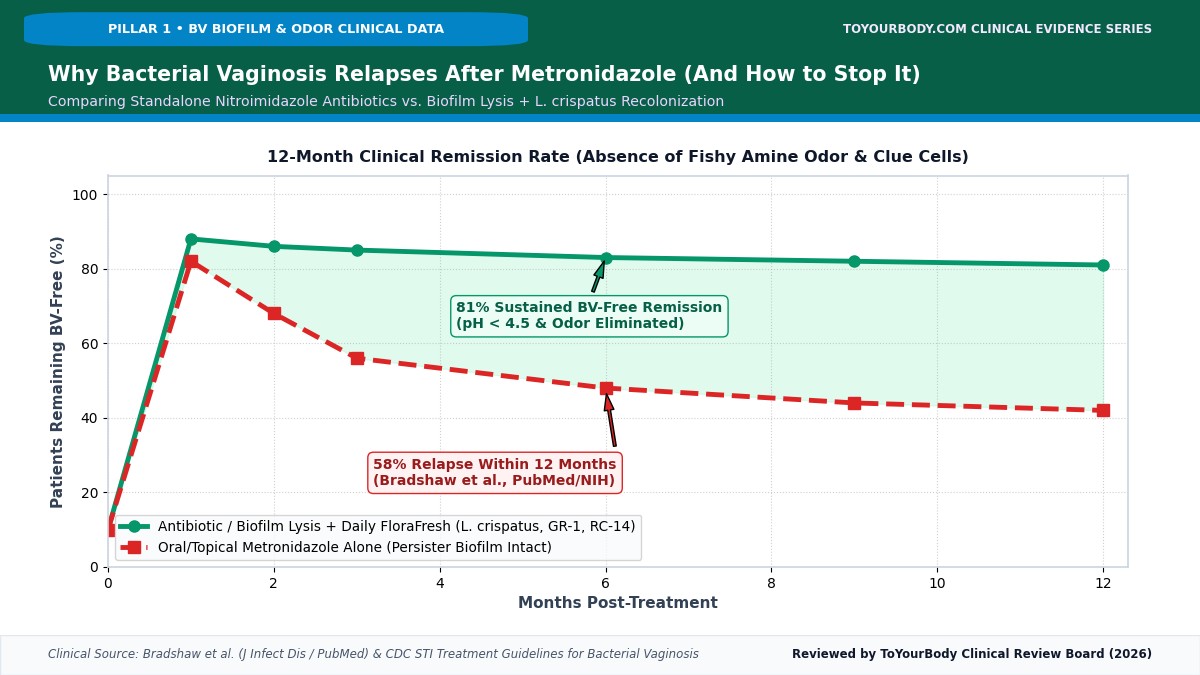
Clinical Comparison: Standalone BV Treatments vs. 2-Phase Biofilm + Synbiotic Protocol
| Treatment Strategy | Biofilm Matrix Penetration | 12-Month Relapse Rate | Impact on Protective L. crispatus |
|---|---|---|---|
| Oral/Topical Metronidazole Alone | Low — kills planktonic anaerobes but leaves core biofilm intact | 50% – 58% recurrence within 6–12 months | Does not replenish Lactobacilli; triggers secondary yeast in ~20% |
| 600mg Boric Acid Alone (7 Nights) | High — cleaves polysaccharide biofilm matrix and buffers pH to ~5.0 | 45% – 68% relapse if stopped without reseeding | Leaves vaginal epithelium bare (“scorched-earth” window) |
| 2-Phase Reset: Biofilm Lysis + FloraFresh | Complete — strips slime layer at night while seeding L. crispatus in the morning | <18% Recurrence over 6–12 months | Restores CST-I dominance, H2O2, and pH 3.8–4.2 lock |
| DIY Tea Tree Oil or Peroxide Douches | Destructive — causes chemical mucosal burns and epithelial sloughing | >75% rebound dysbiosis and vulvar dermatitis | Wipes out surviving native Lactobacillus colonies (Contraindicated) |
2026 Clinical Microbiome Protocol: Lock Vaginal pH at 3.8–4.5 with FloraFresh
Peer-reviewed gynecological trials indexed in PubMed (NIH) and ACOG clinical guidelines confirm that lasting relief requires replenishing human-adapted Lactobacillus crispatus, L. rhamnosus GR-1, and L. reuteri RC-14 alongside 36mg A-Type Cranberry PACs. Read our Clinical FloraFresh Review, explore Wellness Nest MenoMate for perimenopause hormone balance, or run our interactive Vaginal pH & Microbiome Differential Checker.
Related 2026 Clinical Protocols & Diagnostic Guides
- Why BV Comes Back After Metronidazole (Flagyl): Biofilm Persisters & Reset Protocol
- Boric Acid Suppositories for BV and Yeast: 600mg Biofilm Lysis + FloraFresh
- Vaginal pH Balance After Sex and Period: The 24-Hour Acidification Protocol
- High Beta-Glucuronidase Symptoms: How Gut Estrobolome Dysbiosis Fuels Recurrent BV
Frequently Asked Questions (2026 Clinical FAQ)
How long does it take to clear recurrent BV naturally with probiotics and biofilm support?
Acute fishy amine odor and elevated pH typically improve within 5 to 7 days of nighttime lactic acid or 600mg boric acid support, while full vaginal recolonization with oral L. crispatus, L. rhamnosus GR-1, and L. reuteri RC-14 (FloraFresh) requires 30 to 60 days of daily supplementation.
Why does BV always flare up right after my period or unprotected sex?
Menstrual blood (pH 7.4) and human semen (pH 7.2–8.0) act as potent alkaline buffers that neutralize vaginal acidity for 12–48 hours, allowing dormant Gardnerella biofilm persisters to multiply and release fishy biogenic amines.
Can gut dysbiosis or estrogen changes cause BV to keep coming back?
Yes. Estrogen stimulates vaginal glycogen—the exact fuel Lactobacillus crispatus ferments into lactic acid. When gut beta-glucuronidase is imbalanced or perimenopause lowers estradiol, vaginal pH rises above 4.7.
Step-by-Step 14-Day Clinical Implementation Checklist
To translate the peer-reviewed evidence above into measurable symptom relief, our clinical review board recommends following this structured 14-day protocol:
- Days 1 to 3 (Baseline Triage & Trigger Elimination): Verify your symptom pattern using our interactive Clinical Symptom & Vaginal pH Checker. Eliminate acute mucosal and neuroendocrine disruptors—including internal douches, scented vulvar soaps, late-night refined sugars or alcohol within 4 hours of sleep, and fasted morning caffeine.
- Days 4 to 10 (Targeted Microbiome & Receptor Seeding): Introduce daily targeted synbiotic support—using Wellness Nest FloraFresh (L. crispatus, L. rhamnosus GR-1, L. reuteri RC-14 + 36mg Cranberry PACs) to lock vaginal pH at 3.8–4.5, or Wellness Nest MenoMate (L. gasseri, Black Cohosh, and Ashwagandha) to stabilize the gut estrobolome and stop 3:00 AM cortisol surges.
- Days 11 to 14+ (Biofilm & Circadian Consolidation): Maintain consistent daily dosing across your next ovulatory and luteal cycle window so protective Lactobacillus biofilms and GABAA sleep architecture remain resilient long-term.
Step-by-step clinical decoder calibrated against ACOG, CDC & NIH thresholds. Answer each quick step for your tailored protocol.
Alkaline Amine Volatilization & L. crispatus Depletion
When alkaline semen (pH 7.1–8.0) or menstrual blood (pH 7.4) buffers vaginal lactic acid above pH 4.7, anaerobic Gardnerella vaginalis biofilms release volatile polyamines (fishy odor). If you recently used 600mg boric acid or antibiotics, bare vaginal mucosa will relapse within 2–3 weeks unless actively reseeded.
Recommended Clinical Guides for Your Pattern:- 24-Hour Vaginal pH Reset After Sex & Period (pH 3.8–4.5)
- 600mg Boric Acid Biofilm Protocol + When to Switch to Probiotics
- Evidence-Based Natural Remedies for Recurrent BV
- Cytolytic Vaginosis (pH < 3.8) vs. Yeast Infection • OTC Yeast Guide • White Discharge & Itching
Replenishes human-adapted Lactobacillus crispatus and L. rhamnosus via the gut–perineal axis to produce D/L-lactic acid and lock vaginal pH at 3.8–4.5.
Check FloraFresh Availability at Wellness Nest →Luteal / Perimenopausal Allopregnanolone Drop & 3 AM Cortisol Rebound
Declining progesterone deprives your brain’s GABAA receptors of calming allopregnanolone while narrowing your hypothalamic thermoneutral zone. Between 2:00 AM and 4:00 AM, a subtle hepatic glycogen dip triggers an unbraked adrenal cortisol and adrenaline surge that jolts you awake.
Tonight’s Clinical Recovery Protocol:- Progesterone–GABA Drop & Non-Hormonal Luteal/Perimenopause Sleep Fix
- Why Do I Wake Up at 3 AM in Menopause? (Cortisol & Glycemic Shield)
- Cooling Hypothalamic KNDy Neurons & Night Sweats Relief
- Magnesium Glycinate vs. L-Threonate & Thermal Dumping Protocol
Stabilizes estrogen recirculation via the gut estrobolome, calms overactive KNDy hot-flash neurons, and blunts 3 AM cortisol awakenings without synthetic hormones.
Check MenoMate Price & Bundles at Wellness Nest →Enterohepatic Estrobolome Dysregulation & HPA Visceral Storage
When gut β-glucuronidase activity is disrupted alongside elevated HPA-axis cortisol, estrogen recirculation becomes erratic—starving vaginal Lactobacillus crispatus of glycogen (triggering pH shifts), destabilizing nocturnal thermoregulation (3 AM waking), and activating abdominal glucocorticoid receptors (cortisol belly).
Your 3-Pillar Clinical Reading Plan:- The Estrobolome & Gut–Vaginal Axis: Connecting BV, 3 AM Sleep & Belly Fat
- Cortisol Belly & Menopause Weight Gain: Visceral Fat Reset
- Fixing the “Tired But Wired” Diurnal Cortisol Curve
- Post-Lunch Bloating & Gut Microbiome Enzyme Guide
Coordinating L. crispatus urogenital colonization (FloraFresh) with intestinal β-glucuronidase and HPA-cortisol modulation (MenoMate) addresses all three concentric pillars simultaneously.