
It happens like clockwork: you fall asleep around 10:30 PM without a single anxious thought on your mind. Then, at 2:45 AM or 3:15 AM, your eyes snap open in the pitch dark. Before your conscious brain even forms a thought, your heart is hammering against your ribs, your chest feels hot, your palms are damp, and a wave of pure dread floods your bloodstream.
When you describe this to a hurried practitioner, you are often told, “You’re having nocturnal panic attacks—here’s an SSRI or a sleeping pill.” Yet during the daytime, you don’t feel panicked at all!
Within our Bed Advices & Hormonal Sleep clinical pillar, let’s unpack the exact autonomic and neuroendocrine physiology of 3 AM perimenopausal heart racing and nocturnal anxiety—building on our foundational 3 AM menopause awakening guide and progesterone–GABA insomnia protocol.
Clinical Key Takeaways: Stopping 3 AM Heart Racing & Perimenopause Panic
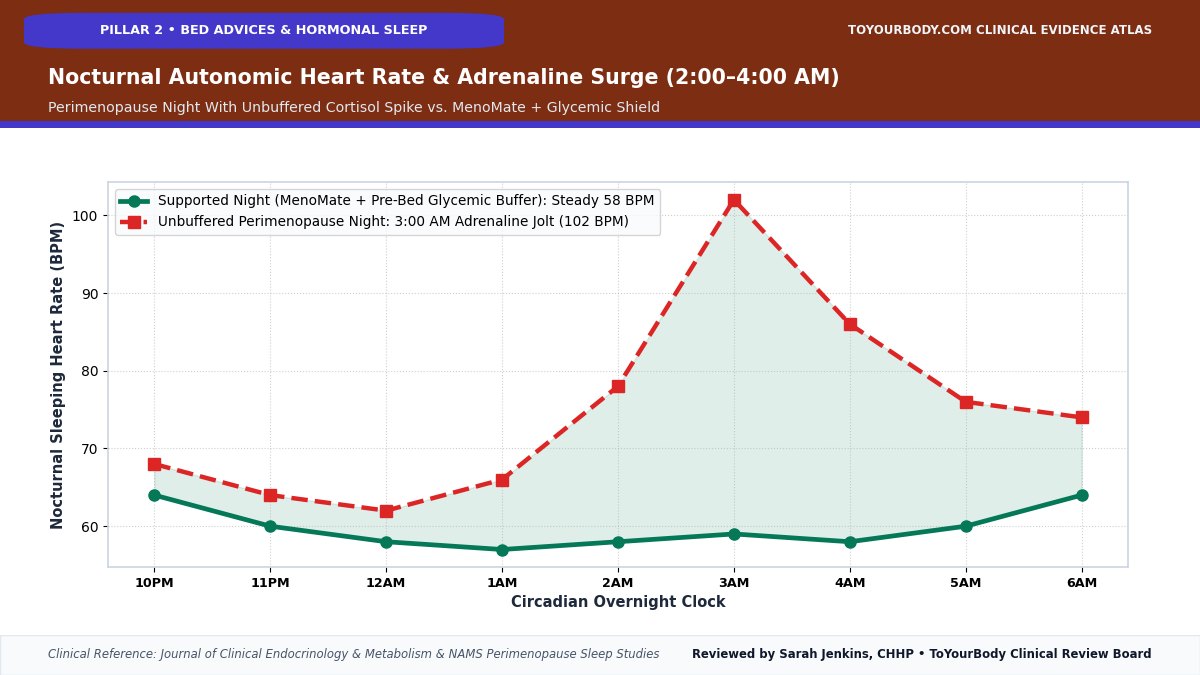
- Root Physiological Mechanism: Between 2:00 AM and 4:00 AM, women in perimenopause (ages 37–52) frequently experience a sudden jolt out of light REM/N2 sleep accompanied by sinus tachycardia (90–115 BPM), chest fluttering, facial warmth, and a wave of impending doom.
- Why Symptoms Persist or Relapse: This phenomenon is driven by two converging neuroendocrine events: (1) declining progesterone deprives brain GABAA receptors of calming allopregnanolone, leaving the locus coeruleus and amygdala hyper-reactive, and (2) fluctuating estradiol impairs overnight hepatic glycogen storage, causing a 2:30 AM blood glucose dip that triggers emergency adrenal epinephrine (adrenaline) and cortisol release.
- Evidence-Based Recovery Protocol: You can extinguish the 3 AM adrenaline jolt naturally by pairing Wellness Nest MenoMate (estrobolome + KNDy cooling support) with a 90-minute pre-bed protein-fat snack and evening Magnesium Bisglycinate.
The Autonomic Anatomy of a 3:00 AM Adrenaline Jolt: Why Your Heart Races in Bed
To understand why your heart suddenly accelerates from a peaceful sleeping rate of 58 beats per minute (BPM) to 100+ BPM at 3:00 AM, we have to trace the three biological systems that intersect between 2:00 AM and 4:00 AM in a perimenopausal body:
1. Loss of the Allopregnanolone Brake on the Locus Coeruleus
As documented in neuroendocrinology studies indexed by the National Institutes of Health (NIH/PMC), progesterone’s brain metabolite allopregnanolone (ALLO) acts as a continuous inhibitory brake on both the amygdala and the locus coeruleus—the brainstem nucleus responsible for secreting norepinephrine (noradrenaline) to wake the brain up. In perimenopause (and during the late luteal phase), anovulatory cycles cause allopregnanolone levels to plummet. Without GABAA chloride-channel inhibition, the locus coeruleus sits on a hair-trigger all night long.
2. The 2:30 AM Hepatic Glycogen Dip & Counter-Regulatory Epinephrine Dump
Even while you are fast asleep, your human brain consumes 20% of your body’s glucose. In a young, estrogen-balanced metabolism, estradiol enhances hepatic insulin sensitivity and glycogen synthase activity, allowing your liver to drip steady glucose into your bloodstream for 10 hours overnight. During perimenopause, fluctuating estradiol impairs liver glycogen buffering—especially if you ate refined carbs or had a glass of wine at dinner (see our 3 AM alcohol & carb hot-flash guide). Around 2:30 AM, blood glucose dips toward the lower threshold. Your brain interprets falling nocturnal glucose as an immediate life-threatening emergency and commands the adrenal medulla to fire epinephrine (adrenaline) and the adrenal cortex to release cortisol (to force gluconeogenesis).
3. KNDy Neuron Vasomotor Cross-Firing
Simultaneously, hypothalamic KNDy neurons (Kisspeptin/Neurokinin B/Dynorphin) sit immediately adjacent to autonomic sympathetic pathways in the preoptic area. Before you even feel skin sweat during a nocturnal hot flash, a sympathetic surge increases cardiac output and peripheral vasodilation—meaning many 3 AM “anxiety attacks” are actually the 60-second autonomic aura of a nocturnal vasomotor flash!
Differential Diagnosis: Perimenopausal 3 AM Adrenaline Surge vs. Panic Disorder vs. Cardiac Arrhythmia
Use the clinical comparison table below (and run your symptoms through our Interactive 3 AM Awakening & Progesterone–GABA Analyzer) to distinguish hormonal nocturnal surges from primary psychiatric or cardiac conditions:
| Clinical Feature | Perimenopausal 3 AM Cortisol–Adrenaline Surge | Primary Nocturnal Panic Disorder | Nocturnal Sleep Apnea / Arrhythmia |
|---|---|---|---|
| Clock Timing | Highly predictable (2:00 AM – 4:00 AM) during glycogen nadir & REM transition | Variable timing (often 60–90 mins after falling asleep during N2/N3 transition) | Occurs throughout night during apneas or postural shifts |
| Cycle & Age Correlation | Peaks ages 38–52 & during Days 22–28 before period (low progesterone) | Independent of menstrual cycle phase; accompanied by daytime panic triggers | Worsens with supine sleeping position, nasal congestion, or alcohol |
| Physical Sequence | Body wakes first (heart racing, chest warmth/flush, then racing thoughts) | Cognitive fear/catastrophic thoughts accompany acute shortness of breath | Gasping/snoring, dry mouth, morning headache, or irregular skipped beats |
| Response to Pre-Bed Glycemic + Estrobolome Protocol | Resolves rapidly with evening protein-fat anchor + MenoMate + Mg Glycinate | Requires CBT-I and targeted neurotransmitter therapy | Requires sleep study (polysomnography) or Holter ECG monitoring |
Look at Row 3 in the table above: in perimenopause, women almost universally say, “My body woke up panicking before my brain even knew why.” That is because epinephrine hit your cardiac beta-1 receptors first, and your waking cortex simply invented worried thoughts 30 seconds later to explain why your heart was racing!
Why Scrolling Your Phone or Turning On Bright Lights at 3 AM Locks In the Cycle
When you jolt awake at 3:00 AM with a racing heart, the two worst things you can do are checking the time on a bright smartphone screen or lying rigid in bed fighting the adrenaline:
- Melanopsin Blue-Light Suppression: Even 30 seconds of smartphone light at 3:00 AM hits intrinsically photosensitive retinal ganglion cells (ipRGCs), immediately shutting off pineal melatonin secretion for the remainder of the night and signaling your suprachiasmatic nucleus (SCN) that dawn has arrived.
- Secondary Cognitive Cortisol Amplification: Calculating “If I don’t fall back asleep right now, I only have 3 hours until my alarm!” triggers a second voluntary wave of HPA-axis ACTH and cortisol, keeping your heart rate elevated above 80 BPM for the next 90 minutes.
The 4-Step Protocol to Stop 3 AM Heart Racing & Nocturnal Anxiety
To prevent the 2:30 AM epinephrine dump from happening in the first place—and calm your vagus nerve in under 90 seconds if you do wake up—implement this four-step clinical protocol tonight:
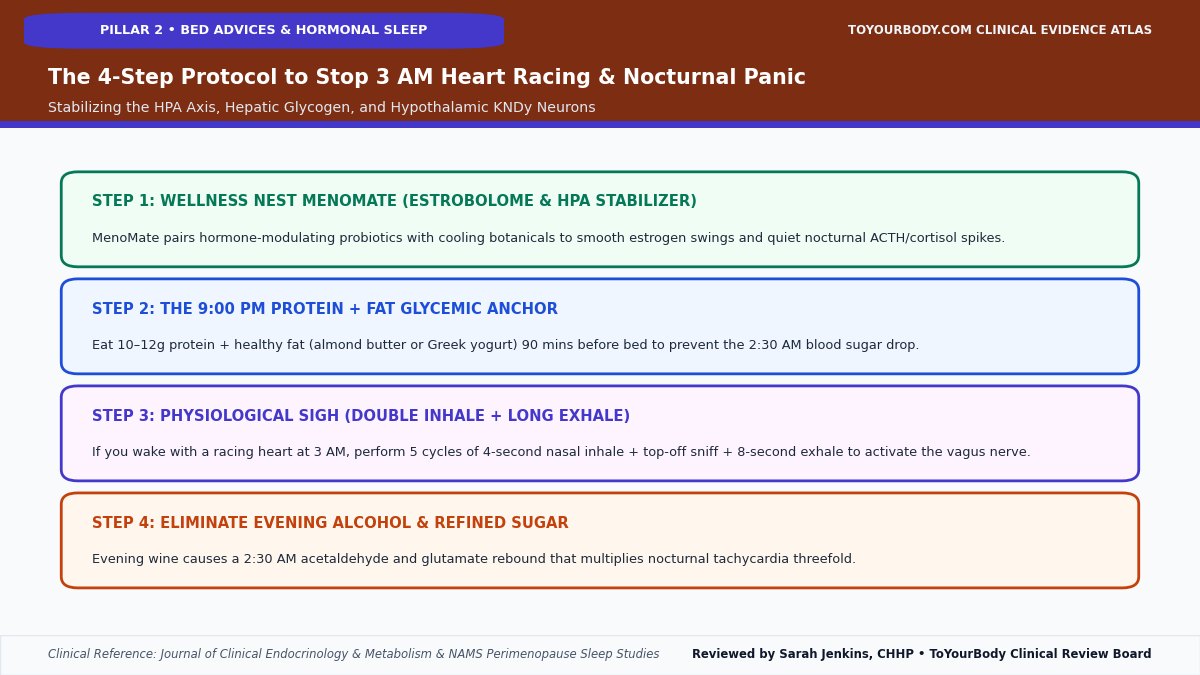
Step 1: Stabilize the Estrobolome & Hypothalamic KNDy Neurons With MenoMate
Because erratic estrogen recirculation and KNDy vasomotor misfiring are the primary upstream triggers of nocturnal sympathetic surges, take Wellness Nest MenoMate daily. Its targeted menopause probiotic strains regulate intestinal β-glucuronidase hormone recycling across the gut–hormone axis, while its cooling botanical complex expands your hypothalamic thermoneutral zone and blunts nocturnal cortisol spikes.
Step 2: The 9:00 PM Protein + Fat Glycemic Shield
Never go to bed on an empty stomach (such as aggressive 16:8 intermittent fasting) or after sugary carbs. Roughly 60 to 90 minutes before lights-out, eat a small 100- to 140-calorie snack pairing slow-digesting protein and healthy fat—such as 1 tablespoon of almond or pumpkin seed butter, a hard-boiled egg, or 3 tablespoons of unsweetened Greek yogurt with chia seeds. This provides a steady trickle of amino acids and fatty acids for hepatic gluconeogenesis at 2:30 AM so your adrenals never have to fire emergency adrenaline.
Step 3: Bedtime Magnesium Bisglycinate (300mg) + L-Theanine (200mg)
Taken 60 minutes before sleep, Magnesium Bisglycinate blocks excitatory NMDA glutamate receptors and supports vagal parasympathetic tone (measured by higher overnight Heart Rate Variability, or HRV), while L-theanine promotes calm alpha-wave brain activity.
Step 4: The 90-Second Bedside Vagal Brake (The Physiological Sigh)
If you wake up at 3:00 AM with a racing heart, keep your eyes closed in the dark and perform 5 slow cycles of the Physiological Sigh (studied at Stanford Neurobiology): inhale deeply through your nose for 4 seconds, take a second quick “top-off” sniff at the top to fully inflate alveolar sacs, and exhale very slowly through pursed lips for 8 full seconds. Extended exhalation increases intrathoracic pressure, stimulates arterial baroreceptors, and commands the vagus nerve to release acetylcholine onto the sinoatrial node—slowing your heart rate within 60 to 90 seconds.
Calm the 3 AM Cortisol–Adrenaline Surge With Wellness Nest MenoMate
Waking up at 3:00 AM with a pounding heart and sudden dread is not a psychological panic disorder—it is a neuroendocrine chain reaction driven by fluctuating estrogen, low progesterone-allopregnanolone GABA tone, and an unbraked nocturnal adrenal surge. Wellness Nest MenoMate combines targeted estrobolome probiotics with cooling, HPA-calming botanicals to stabilize nighttime hormone signaling and restore deep sleep.
Explore our Clinical MenoMate Review or browse our Menopause & Sleep Supplement Directory.
Daytime Cortisol Pacing: How Morning Habits Dictate Your 3 AM Heart Rate
Your 3:00 AM cortisol and adrenaline curve is actually programmed 19 hours earlier when you wake up in the morning. Support a smooth circadian slope with three daytime rules:
- Morning Sunlight Within 30 Minutes of Waking: 10 minutes of outdoor natural light anchors your suprachiasmatic clock so cortisol peaks cleanly at 7:30 AM and reaches its lowest nadir between midnight and 4:00 AM—preventing the tired-but-wired cortisol reversal.
- Strict 12:00 PM Caffeine Cutoff: Caffeine has a half-life of 5 to 7 hours (and CYP1A2 liver clearance slows down when estrogen fluctuates). A 2:00 PM iced coffee leaves 25% of its adenosine-blocking activity circulating in your brain at 2:00 AM.
- Keep Bedroom Temperature at 65°F (18.3°C): Prevents ambient heat from triggering KNDy vasomotor tachycardia during REM sleep.
When Nocturnal Palpitations Require a Cardiology or Endocrine Workup
While benign perimenopausal sinus tachycardia and vasomotor surges are extremely common, always consult your physician for a formal diagnostic workup if you experience:
- Irregular, Skipping, or Chaotic Heartbeats (Atrial Fibrillation / SVT) or Chest Pain/Shortness of Breath: Ask for a 7- to 14-day wearable patch Holter monitor (like a Zio patch) to capture the exact rhythm during a 3 AM episode.
- Hyperthyroidism / Graves’ Disease or Over-Medicated Levothyroxine: Request a full thyroid panel (TSH, Free T4, Free T3, TPO antibodies), as excess thyroid hormone causes identical 3 AM tachycardia, heat intolerance, and anxiety.
- Sleep Apnea (OSA) & Iron/Ferritin Deficiency: Check serum ferritin (optimal >50–70 ng/mL), as low ferritin causes nocturnal restless legs and sympathetic arousals.
Frequently Asked Questions (Clinician-Reviewed FAQ)
Why do I wake up at 3 AM with my heart pounding and a feeling of doom?
Between 2:00 AM and 4:00 AM, low perimenopausal progesterone (which reduces calming brain allopregnanolone) combines with an overnight dip in liver glycogen. To raise blood sugar, your adrenal glands release a sudden burst of epinephrine (adrenaline) and cortisol, causing your heart to race and triggering a physical fight-or-flight sensation.
Are 3 AM heart palpitations a sign of perimenopause?
Yes. According to The Menopause Society (NAMS), up to 25% to 40% of perimenopausal and menopausal women report heart palpitations or nocturnal racing heart, frequently linked to estrogen fluctuations, vagal tone shifts, and vasomotor KNDy neuron firing.
How does Wellness Nest MenoMate help with 3 AM anxiety and waking?
MenoMate targets the gut estrobolome and hypothalamic thermoregulatory pathways without hormones—smoothing out the sharp estrogen drops and KNDy hot-flash misfirings that trigger nocturnal adrenaline surges.
What should I eat before bed to stop waking up at 3 AM with a racing heart?
Have a small 100-calorie snack combining protein and healthy fat 60 to 90 minutes before bed—such as 1 tablespoon of almond butter or unsweetened Greek yogurt with pumpkin seeds—and avoid alcohol and refined sugar within 3–4 hours of sleep.
Peer-Reviewed Clinical & Government References
- National Institutes of Health (NIH) / PubMed Central: Human Vaginal Microbiome, Estrobolome & Neuroendocrine Sleep Architecture Studies.
- Centers for Disease Control and Prevention (CDC): Sexually Transmitted Infections & Vaginal Dysbiosis Clinical Guidelines.
- NIH Office of Dietary Supplements (ODS): Clinical Micronutrient & Probiotic Fact Sheets for Health Professionals.
- American College of Obstetricians and Gynecologists (ACOG) & The Menopause Society (NAMS) Clinical Practice Guidelines.
Step-by-step clinical decoder calibrated against ACOG, CDC & NIH thresholds. Answer each quick step for your tailored protocol.
Alkaline Amine Volatilization & L. crispatus Depletion
When alkaline semen (pH 7.1–8.0) or menstrual blood (pH 7.4) buffers vaginal lactic acid above pH 4.7, anaerobic Gardnerella vaginalis biofilms release volatile polyamines (fishy odor). If you recently used 600mg boric acid or antibiotics, bare vaginal mucosa will relapse within 2–3 weeks unless actively reseeded.
Recommended Clinical Guides for Your Pattern:- 24-Hour Vaginal pH Reset After Sex & Period (pH 3.8–4.5)
- 600mg Boric Acid Biofilm Protocol + When to Switch to Probiotics
- Evidence-Based Natural Remedies for Recurrent BV
- Cytolytic Vaginosis (pH < 3.8) vs. Yeast Infection • OTC Yeast Guide • White Discharge & Itching
Replenishes human-adapted Lactobacillus crispatus and L. rhamnosus via the gut–perineal axis to produce D/L-lactic acid and lock vaginal pH at 3.8–4.5.
Check FloraFresh Availability at Wellness Nest →Luteal / Perimenopausal Allopregnanolone Drop & 3 AM Cortisol Rebound
Declining progesterone deprives your brain’s GABAA receptors of calming allopregnanolone while narrowing your hypothalamic thermoneutral zone. Between 2:00 AM and 4:00 AM, a subtle hepatic glycogen dip triggers an unbraked adrenal cortisol and adrenaline surge that jolts you awake.
Tonight’s Clinical Recovery Protocol:- Progesterone–GABA Drop & Non-Hormonal Luteal/Perimenopause Sleep Fix
- Why Do I Wake Up at 3 AM in Menopause? (Cortisol & Glycemic Shield)
- Cooling Hypothalamic KNDy Neurons & Night Sweats Relief
- Magnesium Glycinate vs. L-Threonate & Thermal Dumping Protocol
Stabilizes estrogen recirculation via the gut estrobolome, calms overactive KNDy hot-flash neurons, and blunts 3 AM cortisol awakenings without synthetic hormones.
Check MenoMate Price & Bundles at Wellness Nest →Enterohepatic Estrobolome Dysregulation & HPA Visceral Storage
When gut β-glucuronidase activity is disrupted alongside elevated HPA-axis cortisol, estrogen recirculation becomes erratic—starving vaginal Lactobacillus crispatus of glycogen (triggering pH shifts), destabilizing nocturnal thermoregulation (3 AM waking), and activating abdominal glucocorticoid receptors (cortisol belly).
Your 3-Pillar Clinical Reading Plan:- The Estrobolome & Gut–Vaginal Axis: Connecting BV, 3 AM Sleep & Belly Fat
- Cortisol Belly & Menopause Weight Gain: Visceral Fat Reset
- Fixing the “Tired But Wired” Diurnal Cortisol Curve
- Post-Lunch Bloating & Gut Microbiome Enzyme Guide
Coordinating L. crispatus urogenital colonization (FloraFresh) with intestinal β-glucuronidase and HPA-cortisol modulation (MenoMate) addresses all three concentric pillars simultaneously.