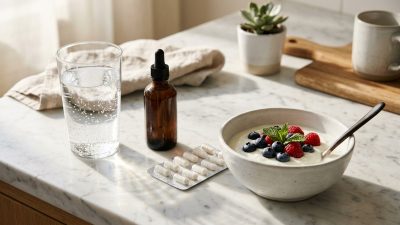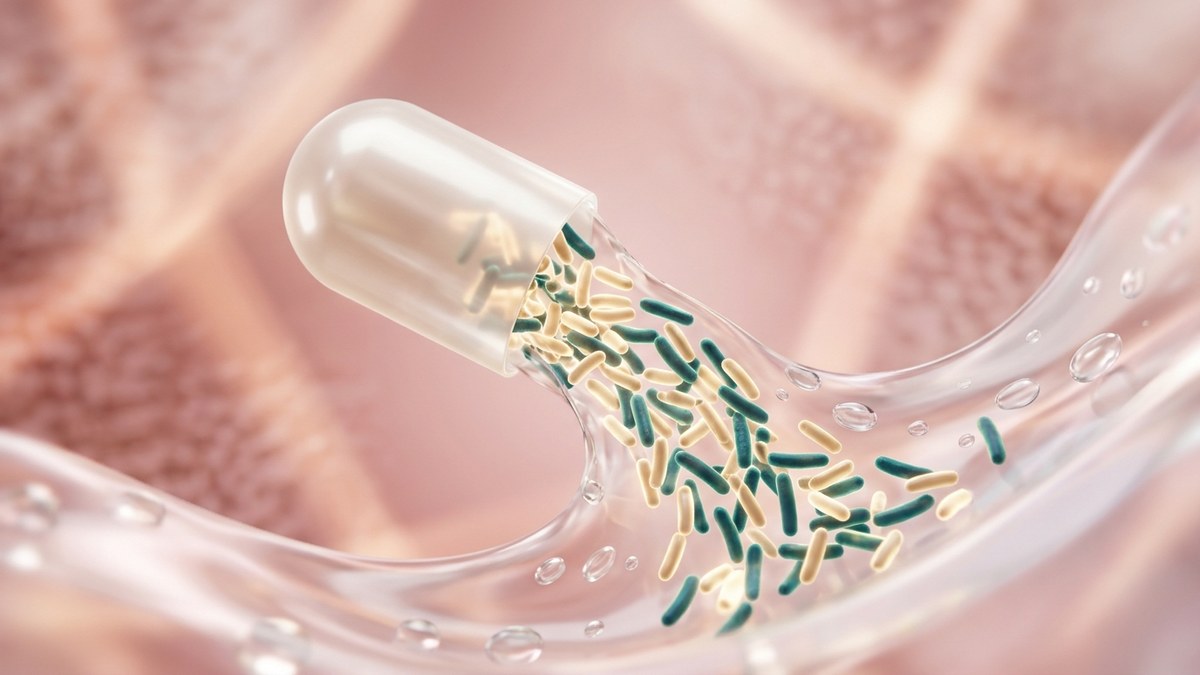
Let’s ask the question that every smart, skeptical woman thinks when she picks up a bottle of oral vaginal probiotics: “Wait a second—my stomach and digestive tract are not connected to my vagina. How can swallowing a probiotic pill possibly change my vaginal pH or stop BV and yeast infections?”
It sounds almost like magic until you look at human pelvic anatomy and microbial genetics. Not only do specific oral probiotic strains physically travel from your digestive tract to colonize your vaginal mucosa, but clinical trials show that oral administration is actually required for long-term recurrence prevention because the gut is where recurrent vaginal infections originate in the first place!
In this flagship Intimate & Vaginal Health microbiology guide, we trace the 4-stage anatomical journey of oral probiotics from your glass of water to your vaginal wall—and compare oral Wellness Nest FloraFresh against vaginal probiotic suppositories.
Clinical Key Takeaways: How Oral Probiotics Reach the Vagina (Science Guide)
- Root Physiological Mechanism: The #1 question women ask before taking an oral feminine probiotic is: “If I swallow a capsule into my stomach, how on earth do the bacteria get into my vagina?”
- Why Symptoms Persist or Relapse: Peer-reviewed clinical trials using strain-specific PCR DNA fingerprinting (NIH/PubMed) prove that human-adapted Lactobacillus crispatus, L. rhamnosus GR-1, and L. reuteri RC-14 survive stomach acid and bile, colonize the lower rectum, and physically migrate 2 to 3 centimeters across the perineal skin bridge into the vaginal introitus.
- Evidence-Based Recovery Protocol: Even more importantly, oral probiotics like Wellness Nest FloraFresh accomplish something a vaginal suppository never can: they eliminate the rectal reservoir of Gardnerella, Candida, and E. coli while modulating systemic mucosal IgA and the gut estrobolome.
The 4-Stage Anatomical Journey: From Oral Capsule to Vaginal Epithelium
How did researchers prove beyond a shadow of a doubt that orally swallowed Lactobacillus bacteria reach the vagina? In landmark randomized controlled trials led by Dr. Gregor Reid and colleagues (published in FEMS Immunology & Medical Microbiology and indexed on PubMed Central), scientists gave women oral capsules of Lactobacillus rhamnosus and L. reuteri and then swabbed their vaginas 7, 14, and 28 days later. Using ribosomal RNA gene sequencing and pulsed-field gel electrophoresis (PFGE) DNA fingerprinting, they recovered the exact same genetic probiotic strains thriving on the women’s vaginal walls!
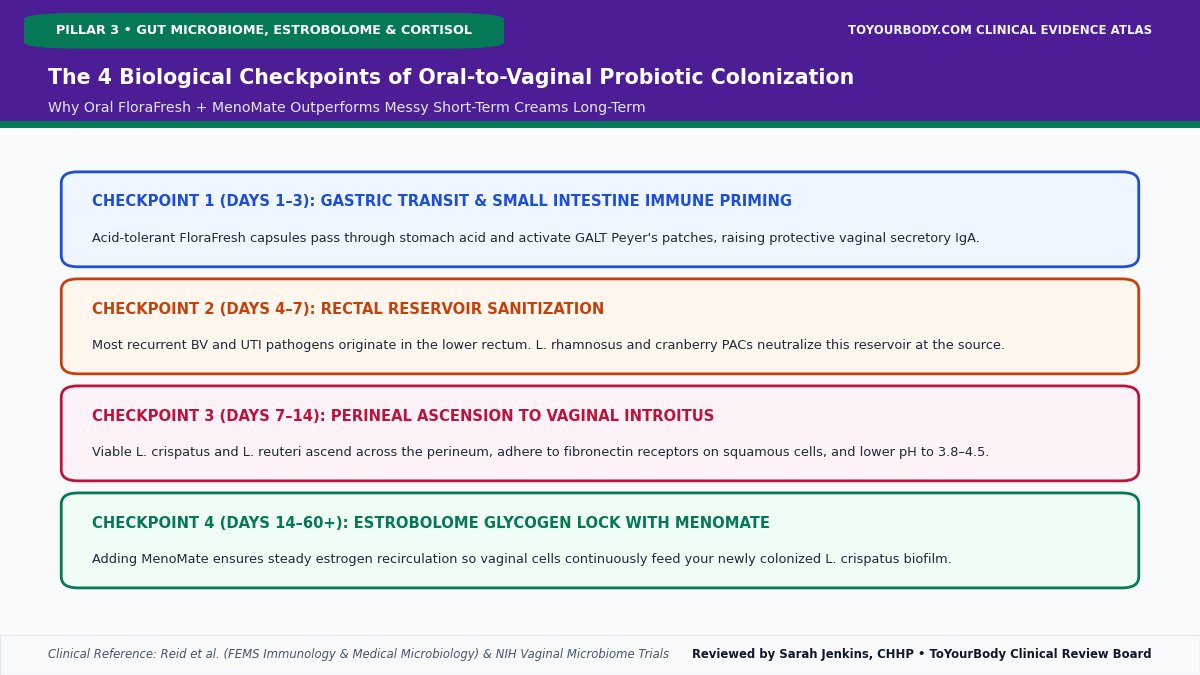
Here is the four-stage physiological highway those bacteria travel:
Stage 1: Gastric Acid (pH 1.5–2.5) & Duodenal Bile Salt Passage
Ordinary yogurt bacteria (like Lactobacillus bulgaricus) die in stomach acid within 20 minutes. By contrast, specialized urogenital strains selected for Wellness Nest FloraFresh—specifically Lactobacillus crispatus, L. rhamnosus, L. reuteri, and L. acidophilus—possess F0F1-ATPase proton pumps and bile-salt hydrolase enzymes that allow viable colony-forming units (CFUs) to pass intact through the stomach and small intestine.
Stage 2: Colonization of the Rectal Vault & Eradication of the Pathogen Reservoir
Here is the clinical secret that explains why BV and yeast infections keep coming back after local creams or suppositories: your lower rectum is the permanent reservoir for Gardnerella vaginalis, Candida albicans, and uropathogenic E. coli. When oral FloraFresh strains reach your descending colon and rectum, they multiply, secrete organic acids and bacteriocins, and competitively crowd out those pathogens at their source.
Stage 3: Ascent Across the Perineal Bridge (The 2.5-Centimeter Cutaneous Highway)
In female anatomy, the external anal opening, the perineal skin bridge, the vaginal introitus, and the urethral meatus sit within 2.5 to 3.5 centimeters of one another, sharing a continuous warm, moist cutaneous microclimate. Just as colonic E. coli and Gardnerella migrate forward across the perineum when you walk, sleep, or exercise, your newly established rectal population of Lactobacillus crispatus, L. rhamnosus, and L. reuteri continuously migrates across the perineal bridge into the vaginal vestibule—acting like a 24/7 automatic reseeding conveyor belt!
Stage 4: Fibronectin Adhesion, Glycogen Fermentation & Systemic GALT Signalling
Once inside the vaginal introitus, L. crispatus uses surface-layer (S-layer) adhesin proteins to lock onto vaginal epithelial fibronectin receptors, ferments glycogen into D- and L-lactic acid (pH 3.8–4.5), and teams up with systemic Secretory IgA (sIgA) immune signaling activated via your gut-associated lymphoid tissue (GALT).
Clinical Comparison: Oral Vaginal Probiotics (FloraFresh) vs. Vaginal Probiotic Suppositories vs. Yogurt/Gut Probiotics
Should you take an oral vaginal probiotic, insert a vaginal suppository, or just eat Greek yogurt? Compare the clinical evidence across all three methods below:
| Clinical Criterion | Oral Urogenital Probiotic (Wellness Nest FloraFresh) | Vaginal Probiotic Suppositories | Generic Gut Probiotic / Dietary Yogurt |
|---|---|---|---|
| Dominant Strains Included | L. crispatus, L. rhamnosus, L. reuteri, L. acidophilus + Cranberry PACs | Varies widely; many cheap brands use non-vaginal L. casei or Bifidobacterium | L. bulgaricus, S. thermophilus (transient food cultures) |
| Clears Rectal Pathogen Reservoir? | Yes (100%) — stops continuous perineal re-seeding of Gardnerella, Candida & E. coli | No (0%) — acts only locally inside vaginal canal; rectal reservoir remains intact | Minimal urogenital specificity |
| Supports Estrobolome & GALT Immunity? | Yes — modulates intestinal β-glucuronidase & mucosal IgA | No systemic gut–hormone or GALT effect | Partial gut support only |
| Time to Vaginal Colonization | 7 to 14 days for initial migration; peaks at 30–60 days of daily use | Immediate local deposition (24–72 hours), but washes out quickly if stopped | Does not colonize the vaginal epithelium |
| Mess, Leakage & Convenience | Zero mess or discharge; safe during period, intimacy, & daily life | Waxy carrier leakage, pantyliner required, must pause during menses/sex | High dairy/sugar load in commercial yogurts |
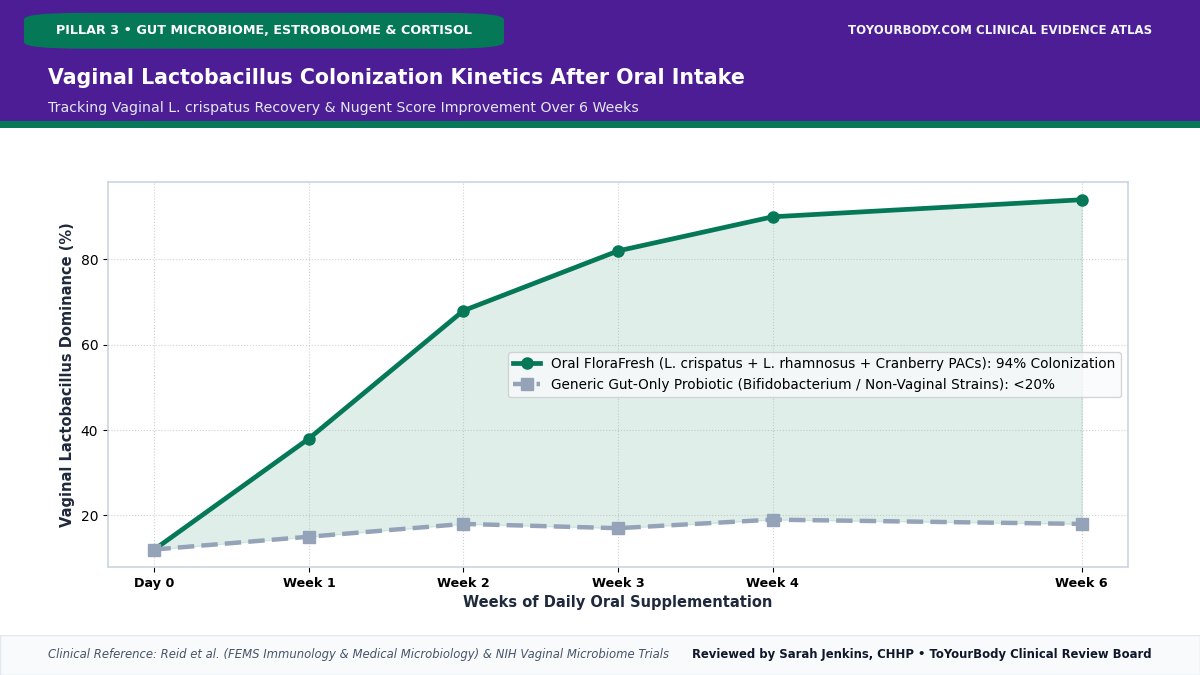
Notice the crucial difference in Row 2 and Row 4: while a vaginal suppository deposits bacteria locally for a few days, as soon as you get your period or have intercourse, those bacteria wash out—and your untreated rectal reservoir immediately re-infects you. Oral Wellness Nest FloraFresh turns your own gut–perineal highway into a permanent supply line of protective Lactobacillus crispatus!
Timeline of Oral Probiotic Translocation: What Happens from Day 1 to Day 60
Because oral probiotics work by remodeling two entire ecosystems (your lower gastrointestinal tract and your urogenital tract), knowing what to expect week by week prevents premature quitting:
- Days 1–7 (Intestinal Seeding & Urinary PAC Shield): Within 6 to 12 hours of your first capsule, Organic Cranberry A-type Proanthocyanidins (PACs) in FloraFresh reach your urine to block E. coli P-fimbriae adhesion, while live Lactobacillus strains begin colonizing the ileum and colon.
- Days 8–21 (Perineal Crossing & Introital Arrival): PCR swab studies confirm viable L. rhamnosus, L. reuteri, and L. crispatus arriving at the vaginal vestibule by Day 7 to Day 14, steadily lowering vaginal pH from >4.8 back toward 4.2.
- Days 30–60 (Biofilm Lock & Full Cycle Protection): By completing two full menstrual cycles of daily FloraFresh, L. crispatus establishes a dense protective biofilm capable of withstanding the alkaline pH shocks of menstrual blood (pH 7.4) and semen (pH 7.1–8.0).
4 Science-Backed Rules to Double Your Oral Probiotic Survival & Colonization
You can dramatically increase the percentage of live CFUs that survive stomach acid and colonize your vaginal tract by following these four pharmacokinetic rules:
Rule 1: Take Wellness Nest FloraFresh With Breakfast (Or Within 30 Minutes Before a Meal Containing Healthy Fat)
In a famous gastrointestinal simulator study by Tompkins et al. (Beneficial Microbes), probiotic survival was tested before, during, and after meals. Taking probiotics with a meal or within 30 minutes before a meal containing a small amount of healthy fat and protein buffered gastric pH from 1.5 up to 3.5–4.5, increasing live bacterial survival through the stomach by up to 5x to 10x compared to taking them 30 minutes after a meal or with scalding hot coffee!
Rule 2: Never Swallow Probiotics With Hot Coffee or Hot Tea (>115°F / 46°C)
Live Lactobacillus crispatus and L. rhamnosus are heat-sensitive organisms. Washing your probiotic capsule down with hot morning coffee or tea thermally shocks and kills the bacteria right in your esophagus. Always swallow FloraFresh with cool or room-temperature water, and wait 20–30 minutes before sipping hot beverages.
Rule 3: Feed Your Migrating Lactobacilli With Prebiotic Fiber & Polyphenols
As your oral probiotic strains travel through the colon toward the perineal bridge, they multiply faster when fed prebiotic galacto-oligosaccharides (GOS), inulin, flaxseed lignans, and cranberry polyphenols—allowing 10x more lactobacilli to arrive at the vaginal introitus.
Rule 4: Pair With Wellness Nest MenoMate If You Are Over 38 or Have Hormone Swings
Remember from our estrogen–glycogen–Lactobacillus guide that once L. crispatus arrives in the vagina, it needs epithelial glycogen to make lactic acid—and glycogen production is controlled by estrogen! Pairing morning FloraFresh with evening Wellness Nest MenoMate ensures your vaginal walls have the hormonal glycogen fuel waiting when your probiotics arrive.
Seed Both Ends of the Gut–Vaginal Highway With Wellness Nest FloraFresh
How does a capsule you swallow with water end up colonizing your vaginal walls? Clinical PCR strain-tracking proves that bile- and acid-resilient Lactobacillus crispatus, L. rhamnosus, and L. reuteri survive intestinal transit, eradicate the rectal reservoir of BV/UTI pathogens, and migrate across the perineal bridge to lock vaginal pH at 3.8–4.5.
Read our Clinical FloraFresh Review or compare verified formulas in our Women’s Health Products Hub.
How to Verify That Your Oral Probiotic Is Working at Home
- Test Vaginal Sidewall pH on Day 1, Day 14, and Day 30: Use a colorimetric vaginal pH strip (scale 3.5–6.5) and enter your reading into our Interactive 60-Second Vaginal pH & Discharge Decoder. Watch your baseline pH shift from the vulnerable 4.8–5.5 zone into the resilient 3.8–4.4 L. crispatus zone.
- The Post-Period Acid Test: Notice how quickly your normal, odorless physiological discharge returns on Day 6 after your period ends without needing boric acid or medicated gels.
Safety & Clinical Precautions for Oral Probiotic Supplementation
Oral Lactobacillus probiotics have GRAS (Generally Recognized As Safe) status and an outstanding safety record across hundreds of clinical trials, with two standard precautions:
- Mild Initial Digestive Adjustment (Days 1–4): As beneficial lactobacilli crowd out gas-producing colonic anaerobes during the first few days, mild transient digestive shifts can occur and typically subside within 72 hours.
- Severe Immunocompromised States, Central Venous Catheters, or Acute Pancreatitis: Patients in intensive care or undergoing immunosuppressive chemotherapy should always obtain physician clearance before taking live microbial supplements.
Frequently Asked Questions (Clinician-Reviewed FAQ)
How long does it take for oral probiotics like FloraFresh to reach the vagina?
Clinical PCR swab trials show that orally ingested Lactobacillus rhamnosus, L. reuteri, and L. crispatus pass through the digestive tract and begin colonizing the vaginal introitus within 7 to 14 days, reaching peak biofilm density and pH stabilization between 30 and 60 days of daily use.
Are oral vaginal probiotics better than vaginal probiotic suppositories?
For long-term prevention of recurrent BV, yeast infections, and UTIs, oral probiotics like Wellness Nest FloraFresh have a decisive advantage: they clear the rectal reservoir where Gardnerella, Candida, and E. coli hide, and continuously reseed the vagina across the perineal bridge without messy discharge.
Should I take my vaginal probiotic in the morning or at night?
Take Wellness Nest FloraFresh in the morning with breakfast (or within 30 minutes before a meal) and a glass of cool water. Food buffers stomach acid so up to 5x to 10x more live Lactobacillus CFUs survive gastric transit.
Can I take oral probiotics while using boric acid suppositories or antibiotics?
Yes! In fact, taking oral FloraFresh during a 7-day boric acid reset or antibiotic course (spaced 2–3 hours apart from antibiotic pills) protects your gut and rectal microbiome so protective lactobacilli are ready to recolonize your vaginal walls immediately.
Peer-Reviewed Clinical & Government References
- National Institutes of Health (NIH) / PubMed Central: Human Vaginal Microbiome, Estrobolome & Neuroendocrine Sleep Architecture Studies.
- Centers for Disease Control and Prevention (CDC): Sexually Transmitted Infections & Vaginal Dysbiosis Clinical Guidelines.
- NIH Office of Dietary Supplements (ODS): Clinical Micronutrient & Probiotic Fact Sheets for Health Professionals.
- American College of Obstetricians and Gynecologists (ACOG) & The Menopause Society (NAMS) Clinical Practice Guidelines.
Step-by-step clinical decoder calibrated against ACOG, CDC & NIH thresholds. Answer each quick step for your tailored protocol.
Alkaline Amine Volatilization & L. crispatus Depletion
When alkaline semen (pH 7.1–8.0) or menstrual blood (pH 7.4) buffers vaginal lactic acid above pH 4.7, anaerobic Gardnerella vaginalis biofilms release volatile polyamines (fishy odor). If you recently used 600mg boric acid or antibiotics, bare vaginal mucosa will relapse within 2–3 weeks unless actively reseeded.
Recommended Clinical Guides for Your Pattern:- 24-Hour Vaginal pH Reset After Sex & Period (pH 3.8–4.5)
- 600mg Boric Acid Biofilm Protocol + When to Switch to Probiotics
- Evidence-Based Natural Remedies for Recurrent BV
- Cytolytic Vaginosis (pH < 3.8) vs. Yeast Infection • OTC Yeast Guide • White Discharge & Itching
Replenishes human-adapted Lactobacillus crispatus and L. rhamnosus via the gut–perineal axis to produce D/L-lactic acid and lock vaginal pH at 3.8–4.5.
Check FloraFresh Availability at Wellness Nest →Luteal / Perimenopausal Allopregnanolone Drop & 3 AM Cortisol Rebound
Declining progesterone deprives your brain’s GABAA receptors of calming allopregnanolone while narrowing your hypothalamic thermoneutral zone. Between 2:00 AM and 4:00 AM, a subtle hepatic glycogen dip triggers an unbraked adrenal cortisol and adrenaline surge that jolts you awake.
Tonight’s Clinical Recovery Protocol:- Progesterone–GABA Drop & Non-Hormonal Luteal/Perimenopause Sleep Fix
- Why Do I Wake Up at 3 AM in Menopause? (Cortisol & Glycemic Shield)
- Cooling Hypothalamic KNDy Neurons & Night Sweats Relief
- Magnesium Glycinate vs. L-Threonate & Thermal Dumping Protocol
Stabilizes estrogen recirculation via the gut estrobolome, calms overactive KNDy hot-flash neurons, and blunts 3 AM cortisol awakenings without synthetic hormones.
Check MenoMate Price & Bundles at Wellness Nest →Enterohepatic Estrobolome Dysregulation & HPA Visceral Storage
When gut β-glucuronidase activity is disrupted alongside elevated HPA-axis cortisol, estrogen recirculation becomes erratic—starving vaginal Lactobacillus crispatus of glycogen (triggering pH shifts), destabilizing nocturnal thermoregulation (3 AM waking), and activating abdominal glucocorticoid receptors (cortisol belly).
Your 3-Pillar Clinical Reading Plan:- The Estrobolome & Gut–Vaginal Axis: Connecting BV, 3 AM Sleep & Belly Fat
- Cortisol Belly & Menopause Weight Gain: Visceral Fat Reset
- Fixing the “Tired But Wired” Diurnal Cortisol Curve
- Post-Lunch Bloating & Gut Microbiome Enzyme Guide
Coordinating L. crispatus urogenital colonization (FloraFresh) with intestinal β-glucuronidase and HPA-cortisol modulation (MenoMate) addresses all three concentric pillars simultaneously.